
Erdoğan and Aliyev Meet in Shusha: The End of Disputes or the Management of Mistrust?
Has the Recent Tension in Turkey-Azerbaijan Relations Come to an End?
 Z
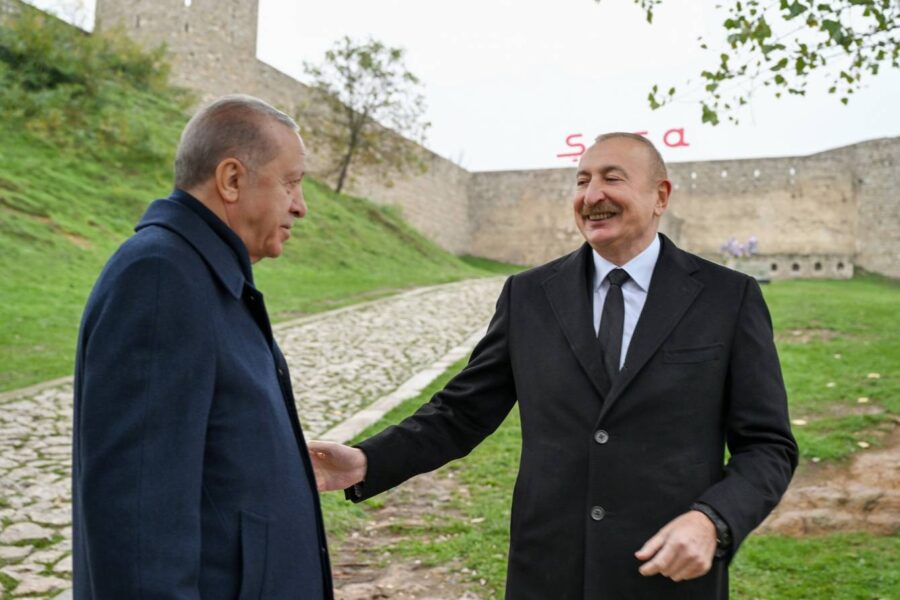
Zaviye Institute: Recep Tayyip Erdoğan’s trip to Shusha and his meeting with Ilham Aliyev, President of the Republic of Azerbaijan, on the country’s Victory Day have once again placed relations between the two important allies in the spotlight. Held after weeks of political and media tensions between Ankara and Baku, the meeting conveyed a clear message about the two sides’ determination to preserve bilateral relations.
The question that arises here is whether this meeting can be interpreted as marking the end of the recent disputes, or whether it should instead be assessed as an effort to contain the tensions and prevent them from spreading to other areas of cooperation?
To answer this question, a distinction must be made between the end of tensions at the political and media levels and the removal of the sources of mistrust in bilateral relations. It appears that the Shusha meeting represented less a resolution of the disputes than an indication that the two sides agree on the need to prevent their escalation.
Read more: Identity Tensions and Strategic Disputes between Ankara and Baku
The Depth of Relations: An Obstacle to the Expansion of Disputes
The first point in analysing relations between Ankara and Baku is the depth and breadth of the two countries’ ties. In recent years, Turkey and the Republic of Azerbaijan have moved their relations beyond the political and cultural spheres and transformed them into an almost strategic partnership in the military, security, energy, trade and transit domains. Turkey’s support for the Republic of Azerbaijan during the Karabakh war and the signing of the Shusha Declaration in 2021 further consolidated the position of this cooperation.
Under such circumstances, the scope of the two countries’ shared interests is so broad that the emergence of disputes over one or more issues is unlikely necessarily to spill over into other areas. In other words, the structure of relations between Turkey and Azerbaijan is such that the political and economic costs of expanding the tensions would be significant for both sides. For this reason, even at the height of the recent disputes, neither government displayed any sign of wishing to fundamentally reconsider its strategic relations with the other.
Erdoğan’s remarks in Shusha about the inviolability of the two countries’ alliance and Aliyev’s emphasis on the eternal nature of these relations can also be assessed within this framework.
The Hijab Issue: A Dispute Extending beyond a Domestic Matter
Nevertheless, the impact of the recent dispute on the political perceptions of both sides cannot be overlooked. The tensions began with the new dress regulations in schools in the Republic of Azerbaijan and the restrictions imposed on female students wearing the hijab. The reaction of certain Turkish officials, political figures and religious circles to this decision was met with serious sensitivity in Baku. From the perspective of officials in the Republic of Azerbaijan, these reactions were regarded as a form of interference in domestic affairs and as calling into question the secular structure of the country’s political system.
Although the Turkish government initially sought to prevent this issue from turning into an official and diplomatic dispute, the statements of some figures close to Erdoğan and the positions expressed in Turkey’s political arena were unwelcome in Baku. The dismissal of Oktay Saral, Erdoğan’s adviser, after he criticised the Republic of Azerbaijan’s education policies also showed that Ankara was prepared to retreat at the political level in order to manage the dispute.
Read more: Will the Ban on the Hijab in Azerbaijan’s Schools Lead to a Rupture in Baku–Ankara Relations?!
Nevertheless, the main issue is not merely a disagreement over the hijab; rather, the incident has created a significant degree of mistrust and suspicion toward Ankara’s approach within political circles in Baku. In fact, as a country highly sensitive to the independence of its decision-making and national sovereignty, the Republic of Azerbaijan reacts to any attempt by Turkey to exert political or cultural influence. This perception had already been observable in certain disputes between the two countries, including the issue of Turkey’s role in the Karabakh war and relations with Israel. It is therefore unlikely that the effects of this mistrust will be dispelled merely by one meeting and a few friendly remarks.
Aliyev’s Allusions: An Indication of the Depth of Baku’s Resentment
One of the most important signs that disputes between Ankara and Baku persist can be found in Ilham Aliyev’s recent rhetoric. The President of the Republic of Azerbaijan had previously made unprecedented remarks in a speech at the eighth congress of the ruling New Azerbaijan Party, without directly naming Turkey; these remarks were interpreted in the Turkish media and political circles as explicit allusions to Ankara.
In part of this speech, Aliyev referred to the concept of the “big uncle” and stressed that the Republic of Azerbaijan has no big uncle and is dependent on no country’s support. Referring also to the Karabakh war, he claimed that his country had received support from no one under difficult circumstances and had purchased all the weapons it needed at global market prices; in some cases, it had even paid several times the usual price and received no discounts.
The significance of these remarks lies in the fact that Turkey has consistently presented its support for the Republic of Azerbaijan during the Karabakh War as one of the most important symbols of the two countries’ alliance, and this support has occupied a prominent place in Ankara’s political discourse. For this reason, Aliyev’s remarks in Turkey were reflected as calling into question Ankara’s narrative about its role in the Republic of Azerbaijan’s victory.
In another part of his remarks, without directly referring to Turkey, Aliyev stressed, addressing critics of Baku’s domestic policies, that no country should interfere in the lifestyle and internal affairs of the Republic of Azerbaijan and that everyone should attend to the affairs of their own country. These remarks were also made amid criticism from Turkish political and religious circles of restrictions on the hijab in Azerbaijani schools, and were interpreted as an implicit reaction to Turkey’s positions.
Taken together, these remarks indicate that the recent disagreements were not merely confined to a diplomatic misunderstanding, but were connected to sensitive issues such as political independence, the manner in which the bilateral alliance is defined, and the limits of interference in each other’s internal affairs. For this reason, even if the two governments officially stress the preservation of relations, it is unlikely that the effects of these statements and the mistrust they have created will disappear in the short term.
Conclusion
Overall, Erdoğan and Aliyev’s meeting in Shusha should be viewed as a sign of the two sides’ efforts to manage their differences and prevent damage to their strategic partnership, rather than necessarily as a complete end to the tensions. The depth of Turkey’s and the Republic of Azerbaijan’s economic, security and military relations makes it difficult for temporary disagreements to spread easily to all aspects of bilateral relations; however, this does not mean that structural differences and mutual sensitivities are absent.
It appears that, at the present juncture, Ankara and Baku agree above all on preserving the framework of their alliance and preventing their disagreements from becoming public. Nevertheless, the mistrust created over the issue of the hijab, Aliyev’s sensitivity regarding the Republic of Azerbaijan’s political independence, and his pointed remarks about Turkey’s role in the Karabakh War remain in place.
Reader comments