
Baku’s Strategic Shift in the Caucasus Balance of Power
Reasons for the Revival of Russia–Azerbaijan Military Relations
 D
Zaviye Institute: For several consecutive years, military relations and cooperation between the Republic of Azerbaijan and Russia had fallen to zero. This sharp decline in military cooperation occurred despite the fact that, for a long period, Russia had been the Republic of Azerbaijan’s largest supplier of weapons and ammunition.
In the 2000s and 2010s, Russia sold billions of dollars’ worth of weapons to Azerbaijan: from T-90 tanks, BMP-3 infantry fighting vehicles and BTR-82 armoured personnel carriers to S-300 air-defence systems and various new radar systems; and from Msta and Vena artillery systems to Kornet anti-tank missiles; and from MiG-29 fighter jets to Mi-35 and Mi-8 helicopters. During this period, Russia supplied between 60 and 80 percent of Baku’s required armaments. However, this relationship was disrupted and severed for a period.
Read more: Russia–Azerbaijan Relations on a Path of Transformation and Their Outlook
From Arms Dependence on Moscow to Diversification of Military Sources
First, after the seizure of Crimea and the short war with Ukraine in ۲۰۱۵, Russia was subjected to heavy US and European sanctions. US sanctions against Russia under the CAATSA led many countries to cancel numerous Russian arms-sale contracts out of fear of sanctions. Azerbaijan, too, decided to reduce its arms purchases from Russia in order not to become embroiled in a confrontation with the United States.
Second, the Republic of Azerbaijan sought to turn to new sources such as Israel, Turkey, China and Pakistan, as well as smaller producers such as Serbia, the Czech Republic and Italy. This led it to reduce its reliance on Russia. From Ilham Aliyev’s perspective, having Russia as the exclusive supplier of his country’s armaments was cause for concern and granted Moscow a form of veto power. Baku has always feared Russian coercion as its historic threat.
Read more: Russia’s Concern over the Expansion of Azerbaijan’s Military Cooperation with Its Neighbours
Third, the Republic of Azerbaijan had concluded that Russian weapons were inferior to Western weapons in terms of quality. By purchasing Western-technology weapons from Israel, Turkey and several European countries, Azerbaijan had increasingly recognised this difference in performance and quality. Moreover, Azerbaijan had always sought to widen its military superiority over Armenia, and for this purpose Western systems received increasing attention in Baku. This difference in performance manifested itself in Turkey’s conflicts in Syria and Libya, the Second Nagorno-Karabakh War in 2020, and the Russia–Ukraine war from 2022 onward.
Fourth, after Russia invaded Ukraine in 2022, comprehensive US and European pressure on various countries to reduce their relations with Russia increased. The risk of being sanctioned by the United States and Europe for colluding with Russia by helping it circumvent sanctions had risen sharply. As a result, Azerbaijan, like many other countries, decided to reduce its military relations with Russia. Russia, for its part, has been heavily engaged in supplying weapons and ammunition to its armed forces since the war with Ukraine began, and has even become an importer of weapons and ammunition from countries such as North Korea, Iran and Belarus. Although Russia has continued to export weapons, the volume of these exports has declined sharply.
From the Passenger Plane Crash to Security and Diplomatic Confrontation
During this period, Azerbaijan also witnessed serious tensions in its relations with Russia. The targeting of an Azerbaijani passenger plane by Russian air defences (on the assumption that it was a Ukrainian drone) severely strained relations between the two sides. Azerbaijan demanded compensation as well as an apology from Russia, and even threatened to sue Moscow before the International Court of Justice. Likewise, Russians residing in Azerbaijan and Azerbaijanis residing in Russia each faced security-related prosecution by the other side.
In the city of Yekaterinburg, Russian police detained dozens of citizens of Azerbaijani origin in connection with an old organised-crime case; two of them (the Safarov brothers) died in custody. Baku described the action as “systematic torture and violence” and, in addition to summoning the ambassador, regarded the process of stripping prominent Azerbaijanis in Russia of their citizenship and deporting them as an attempt to exert political pressure on Baku.
The Ukraine Conflict and the Caucasus; New Dimensions of the Disputes between Baku and Moscow
In response to the Yekaterinburg incidents, Azerbaijani security forces raided the Baku office of the Russian news agency Sputnik, suspended its activities, and arrested and sentenced to imprisonment a number of journalists and Russian citizens on charges including espionage and drug trafficking. Russia had also provoked Azerbaijan’s anger through its attacks on Ukraine. Damage to facilities belonging to the State Oil Company of the Republic of Azerbaijan (SOCAR) in Russian attacks led to a new wave of Baku’s diplomatic protests and the convening of meetings with strongly anti-Russian rhetoric, including the Shusha Conference on Russia’s colonial policies. Some sources in Russia, for their part, accused Azerbaijan of secretly selling certain arms supplies to Ukraine.
Some media outlets claimed that the Azerbaijan Defense Industry Organization (CIHAZ) had sent arms shipments, under the label of “humanitarian aid,” to Turkey, then to Sudan, in cooperation with the Rapid Support Forces, and from there to the German port of Hamburg and ultimately to Ukraine. Azerbaijan rejected all these claims and responded sharply, warning that if the allegations continued, it would in fact sell weapons and ammunition to Ukraine. Russia was also displeased that Azerbaijan had rejected Moscow’s mediation concerning Armenia, instead turned to Trump, and paved the way for the United States to re-enter the South Caucasus.
Read more: From Rupture to the Normalization of Russia-Azerbaijan Relations
New Russia-Azerbaijan Military Cooperation Agreement
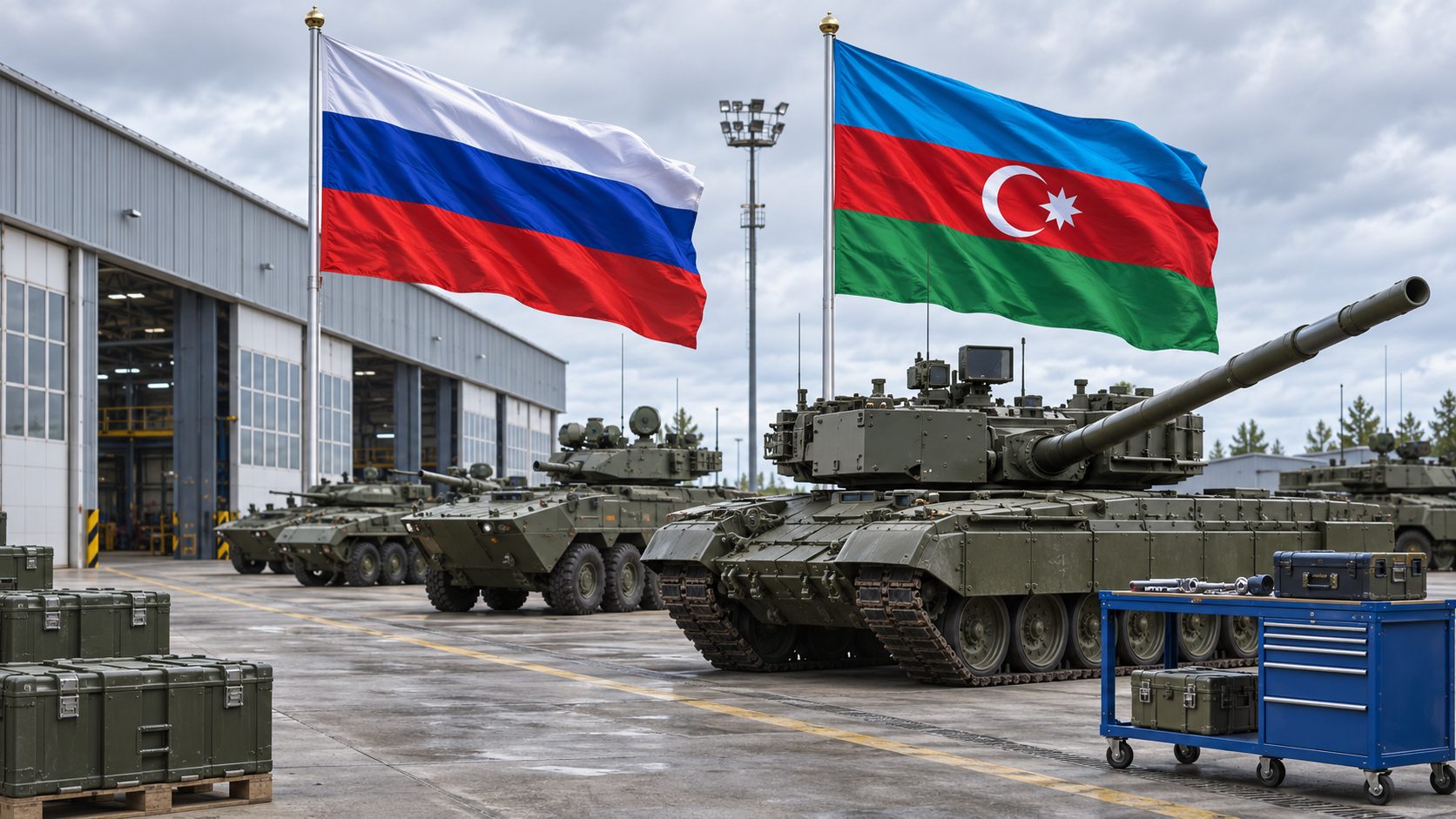
Against this backdrop, Baku’s return to purchasing weapons from Russia has surprised many. Russia and Azerbaijan have unexpectedly signed an agreement to build and modernize repair facilities for the armored vehicles used by the Azerbaijani army. The agreement was announced on November 1, two days after the Organization of Turkic States (OTS) summit in Ankara, which Azerbaijani President Ilham Aliyev did not attend amid growing tensions with Turkey.
Dmitry Shugayev, head of Russia’s Federal Service for Military-Technical Cooperation, announced that a comprehensive program had been signed between Azerbaijan and Russia providing for the modernization and construction of facilities to repair armored vehicles in service with the Azerbaijani army. The program focuses on the modernization and repair of the following fleets: T-90 tanks, of which Azerbaijan had purchased 100 and 93 remain in service after the Karabakh war; BMP-3 infantry fighting vehicles, of which Azerbaijan still has 118 in service; and BTR-82 and BTR-80 armored personnel carriers, of which Baku had previously purchased 230 and 187, respectively, with 32 of them lost in the Second Karabakh War. Shugayev also reported Azerbaijan’s interest in purchasing the Pantsir air-defense system (SA-22).
Doubts About Russia’s Ability to Implement the New Military Agreement
Some in Azerbaijan suspect that Moscow will be unable to fulfill its obligations under the agreement. In their view, Russia itself is currently facing serious difficulties in repairing and modernizing its armored fleet amid its war with Ukraine. Russia has lost a substantial portion of its armored inventory in the war with Ukraine, while Russian armored units themselves are awaiting modernized or repaired equipment. In addition, Russia faces shortages of spare parts and specialists capable of repairing this armored equipment, and it is unclear how Russia intends to meet its commitments. Some Azerbaijani military experts have warned that Russia may eventually use the capacity of these repair facilities to support its war machine in Ukraine as well.
Reasons for the Revival of Russia-Azerbaijan Military Relations
Attention to developments over the past several months indicates that Azerbaijan’s renewed turn toward Russia has been a highly political and reactive move by Aliyev. It is true that Russia managed to win Baku’s approval by paying compensation for the downed Azerbaijani aircraft and stopped putting pressure on Baku’s citizens inside Russia, but the main reason for Baku and Moscow’s renewed rapprochement is the tension that has emerged in Azerbaijan-Turkey relations.
On the surface, the Republic of Azerbaijan is displeased with Turkey’s interference in the issue of the hijab worn by female students in its schools. Erdoğan and his supporters, who represent a form of post-Islamist ideology, were deeply disillusioned by the Aliyev government’s action. Yet even greater than this disillusionment was Aliyev’s sharply confrontational stance toward Turkey. In his remarks, Aliyev effectively declared the end of “Turkic brotherhood” and described Azerbaijan as an independent country in whose internal affairs no one has either the right or the ability to interfere. Azerbaijan’s distancing from Turkey is highly visible and unmistakable.
In this distancing, Israel is also a very important variable. Aliyev has decided to choose the latter between Turkey and Israel. In his view, the international system (which, in essence, means the United States) is with Israel, not Turkey, and Jewish power in the world offers a more credible choice and security guarantee than Turkish support. To the same extent that Aliyev has distanced himself from Turkey, he appears to have decided to move closer to Russia. For Aliyev, the fact that the Western-oriented Pashinyan in Armenia is an unwelcome element for Moscow is also reassuring. In reality, through new military contracts, Azerbaijan is both addressing its extensive need for spare parts and maintenance for its Russian weaponry, and signalling to Turkey that Baku has no structural security or arms dependence on Turkey and can procure the weapons it needs from Russia or elsewhere (such as Israel or China, among others). In Aliyev’s words, when there is money to buy weapons, there is no point in acting as though one is doing the buyer a favour by selling them.
Reader comments