
Moving Beyond Geopolitical Tensions Amid India’s Rivalry with Pakistan and Defence Cooperation with Armenia
India–Azerbaijan Détente: Energy and the North–South Corridor at the Core of a Cautious Rapprochement
 Z
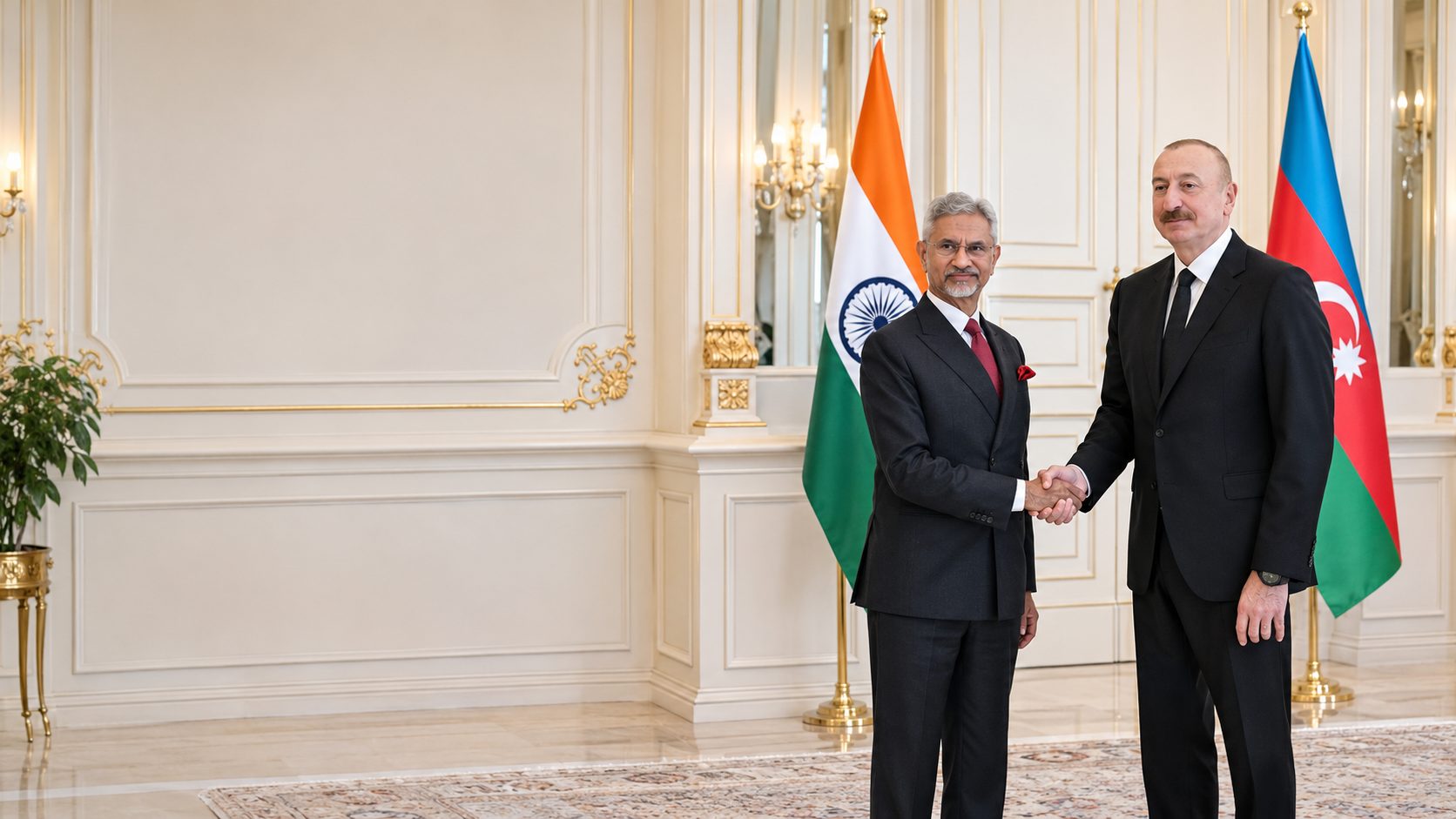
Zaviye Institute: Recent developments in relations between India and Azerbaijan, particularly the visit of Indian Foreign Minister Subrahmanyam Jaishankar to Baku and his meetings with Ilham Aliyev and Jeyhun Bayramov, signal the beginning of a new phase of pragmatism in bilateral relations. Relations, which had come under strain due to Baku’s support for Pakistan and New Delhi’s defense cooperation with Armenia, are now moving toward managing differences and strengthening economic cooperation. Nevertheless, this development should not be interpreted as the end of geopolitical competition; rather, it can be assessed as an effort to separate security disputes from economic and transit interests.
From Political Confrontation to the Management of Strategic Differences
The roots of mistrust between India and Azerbaijan should be sought in the two countries’ intersecting security ties. Baku’s traditional support for Pakistan’s positions on Kashmir and India’s expanding military cooperation with Armenia have led to a form of indirect balancing among actors in South Asia and the South Caucasus.
These differences intensified after the India–Pakistan military confrontation in May 2025 (April–May 1404), when Azerbaijan’s political support for Islamabad provoked a negative reaction in New Delhi. However, the meeting between Narendra Modi and Ilham Aliyev on the sidelines of the Shanghai Cooperation Organisation summit on 1 September 2026 (23 August 1405), followed by Jaishankar’s visit to Baku, demonstrated that both sides have come to pay greater attention to the need to prevent disputes with third countries from spilling over into bilateral relations.
Read more: The Role of Turkey, India and Egypt in Global Food Security
Energy Diplomacy: An Economic Driver of De-escalation
One of the most important factors behind the change in the two countries’ approach is the growing importance of energy security and the diversification of oil supplies. For India, Azerbaijan, in addition to possessing hydrocarbon resources, provides access to oil via the Baku–Tbilisi–Ceyhan pipeline, a route that does not depend on the Strait of Hormuz for the direct transport of oil.
The investment of more than $1.2 billion by the Indian company ONGC Videsh in the Azeri–Chirag–Gunashli oil fields and the Baku–Tbilisi–Ceyhan pipeline demonstrates the existence of established economic interests between the two sides.
Moreover, the increase in bilateral trade to approximately $600 million in the first half of 2026 (December 2025 to July 2026), compared with $401 million for the whole of 2025 (December 2024 to December 2025), indicates the geoeconomic potential of the relationship. From this perspective, energy can become a tool for reducing the political costs of bilateral disputes.
The North–South Corridor: Linking the Interests of India, Azerbaijan and Iran
Azerbaijan’s transit position along the International North–South Transport Corridor adds another strategic dimension to de-escalation. To expand access to Russia, Central Asia and Eurasian markets, India needs to develop alternative routes and reduce transportation costs.
In this context, Azerbaijan can serve as the link connecting Iran’s and Russia’s transport networks. Baku, in turn, will benefit from increased volumes of Indian goods in transit and from strengthening its position in Eurasian trade chains.
For Iran, improved relations between New Delhi and Baku could provide an opportunity to increase the utilisation of the North–South Corridor’s capacities, provided that the completion of shared infrastructure—particularly the Rasht–Astara railway—is pursued more rapidly.
Further reading: China and Azerbaijan: Linking Energy, Technology and the Middle Corridor
India’s Continued Cooperation with Armenia: A Constraint on De-escalation
Despite the expansion of diplomatic interactions, defense cooperation between India and Armenia remains one of the most important constraints on relations between New Delhi and Baku. From Azerbaijan’s perspective, India’s sale of military equipment to Yerevan could affect the security balance in the South Caucasus.
New Delhi, for its part, is also sensitive to the depth of Baku’s strategic relationship with Islamabad. Therefore, the continuation of de-escalation requires the acceptance of a degree of relative independence in the foreign relations of both sides; that is, cooperation with Armenia or Pakistan should not necessarily lead to direct confrontation between India and Azerbaijan.
Outlook
Overall, the de-escalation between India and Azerbaijan can be regarded as a sign of a gradual shift from rigid geopolitical alignments toward a model of issue-based cooperation. Under this model, security differences persist but do not constitute an absolute obstacle to the development of economic relations.
From the perspective of Iran’s interests, this development creates an opportunity to strengthen the country’s transit and geoeconomic role in connecting South Asia with the Caucasus and Eurasia. However, capitalising on this opportunity requires active diplomacy, the acceleration of infrastructure projects and the preservation of balanced cooperation with India, Azerbaijan and Armenia.
Ultimately, the sustainability of the de-escalation between New Delhi and Baku will depend less on political convergence than on the parties’ ability to translate their shared economic interests into durable mechanisms of cooperation.
Reader comments