
The Contradiction Between Baku’s Narrative and the Security Realities of the South Caucasus
South Caucasus: Peace or Great-Power Rivalry?
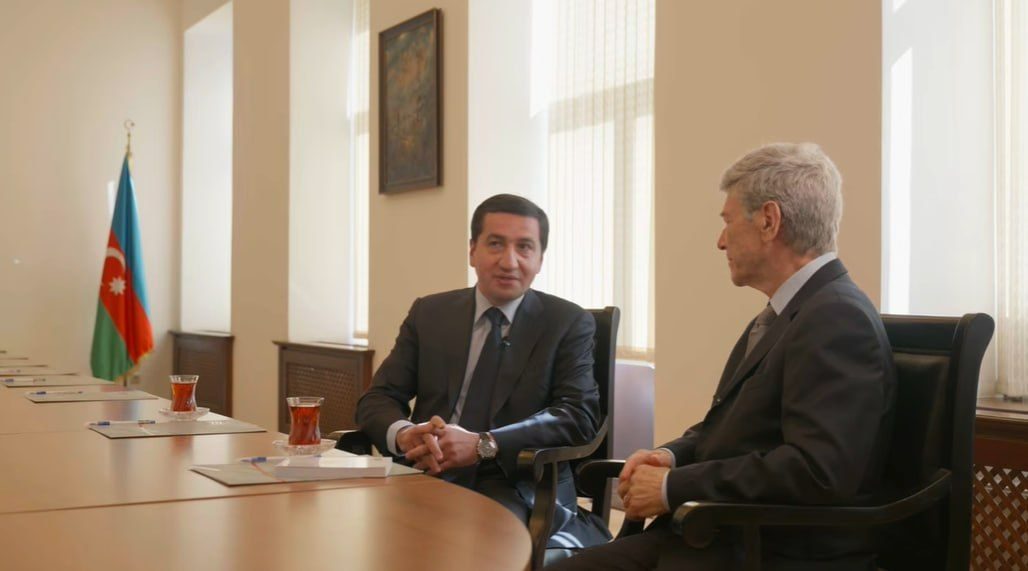
Zaviye Institute: The recent remarks by Hikmat Hajiyev, Assistant to the President of the Republic of Azerbaijan, during his meeting with Jeffrey Sachs, a professor at Columbia University, have once again raised the issue of the future of the South Caucasus security order. On 30 October 2026, Hajiyev claimed that the Republic of Azerbaijan had succeeded in transforming the South Caucasus from a battleground for great powers into an arena of joint cooperation. He also spoke of Baku’s efforts to establish lasting peace, develop connectivity corridors and shape a new security architecture. However, an examination of regional developments shows that there are significant questions and contradictions between the image portrayed by Baku and the complex geopolitical realities of the Caucasus.
Regional Peace or the Reconfiguration of Great-Power Rivalry?
There is no doubt that reducing tensions between the Republic of Azerbaijan and Armenia and expanding economic connectivity could create new opportunities for regional stability. However, reducing the likelihood of war between the two countries does not necessarily mean the end of great-power rivalry.
The South Caucasus remains a crossroads of the interests of Russia, Türkiye, Iran, the United States and the European Union. Developments in recent years have also shown that, alongside changes in Russia’s position, other actors have become more active in expanding their economic, political and security roles.
From this perspective, what Hajiyev presents as the end of the arena of rivalry could, from another angle, be regarded as a change in the form of competition and a redistribution of influence among regional and extra-regional actors.
Expanding Military Cooperation with Israel: A Question Concerning Collective Security
One of the most important issues receiving less attention in Baku’s peace-oriented narrative is the Republic of Azerbaijan’s defence and security relations with Israel.
In May 2025 (Ordibehesht 1404), Azerbaijan’s defence minister visited Israel and met with senior military officials of that country, and the two sides discussed the expansion of military, technical and training cooperation. This cooperation has continued at a time when relations between Iran and Israel have been accompanied by serious security tensions.
It is natural for Baku to regard its defence cooperation as part of its sovereign right and the necessity of modernising its armed forces. Tehran, by contrast, may assess the expansion of Israel’s military and intelligence access in the vicinity of its borders as a potential threat.
Accordingly, designing a sustainable security architecture without addressing the security concerns of neighbouring countries will face structural difficulties.
The United States and NATO: An End to Rivalry or an Expansion of Presence?
Another dimension of the contradiction between the narrative of comprehensive cooperation and developments on the ground is the intensification of security interactions with the West.
The visit of NATO’s Special Representative of the Secretary General to Baku in June 2026 (Tir 1405), and talks on defence cooperation, military training and the interoperability of forces, demonstrate the continuation of the Republic of Azerbaijan’s security relations with the alliance. Of course, this cooperation does not mean Azerbaijan’s membership in NATO or the deployment of a NATO military base.
At the same time, the “Trump Route” project, with a projected 74 percent controlling stake for the American side in the route development company, will facilitate Washington’s long-term economic and managerial presence in southern Armenia. Although the agreement emphasises the preservation of Armenia’s sovereignty, the potential security implications of such a presence require careful assessment.
These developments show that the influence of foreign powers has not been removed from the Caucasus equation, but is being pursued in new forms.
Read more: Trump Corridor: A Transit Opportunity or a Geopolitical Threat to Iran?
Permanent Peace: The Gap between Stated Positions and a Final Agreement
Hajiyev speaks of choosing “permanent peace,” but Baku continues to make amendments to Armenia’s constitution a condition for the final signing of a peace agreement. This indicates that the political and legal disputes between the two countries have not yet been fully resolved.
Therefore, achieving sustainable peace requires clear legal agreements, mutual confidence-building and effective dispute-resolution mechanisms—not merely the expansion of transit projects.
Conclusion
Hikmat Hajiyev’s remarks reflect Baku’s desire to present itself as a pivotal actor in the new order of the Caucasus. However, the success of such an approach will depend on the extent of the genuine participation of other countries in the region.
The central challenge is that the expansion of economic cooperation, alongside the strengthening of military and security ties with extra-regional powers, could generate divergent perceptions of peace and stability.
Read more: Iran–Armenia Strategic Partnership: Opportunities and Security Red Lines
Sustainable peace in the South Caucasus will enjoy regional support when, while respecting the sovereignty of states, the legitimate security concerns of neighbouring countries are also taken into account in future arrangements. Otherwise, the reduction of traditional conflicts may be accompanied by the emergence of new security rivalries.
Reader comments