
Ankara’s Security Strategy in the Middle East
Turkey’s Defense Pacts: Instruments of Influence or Military Commitments?
 M
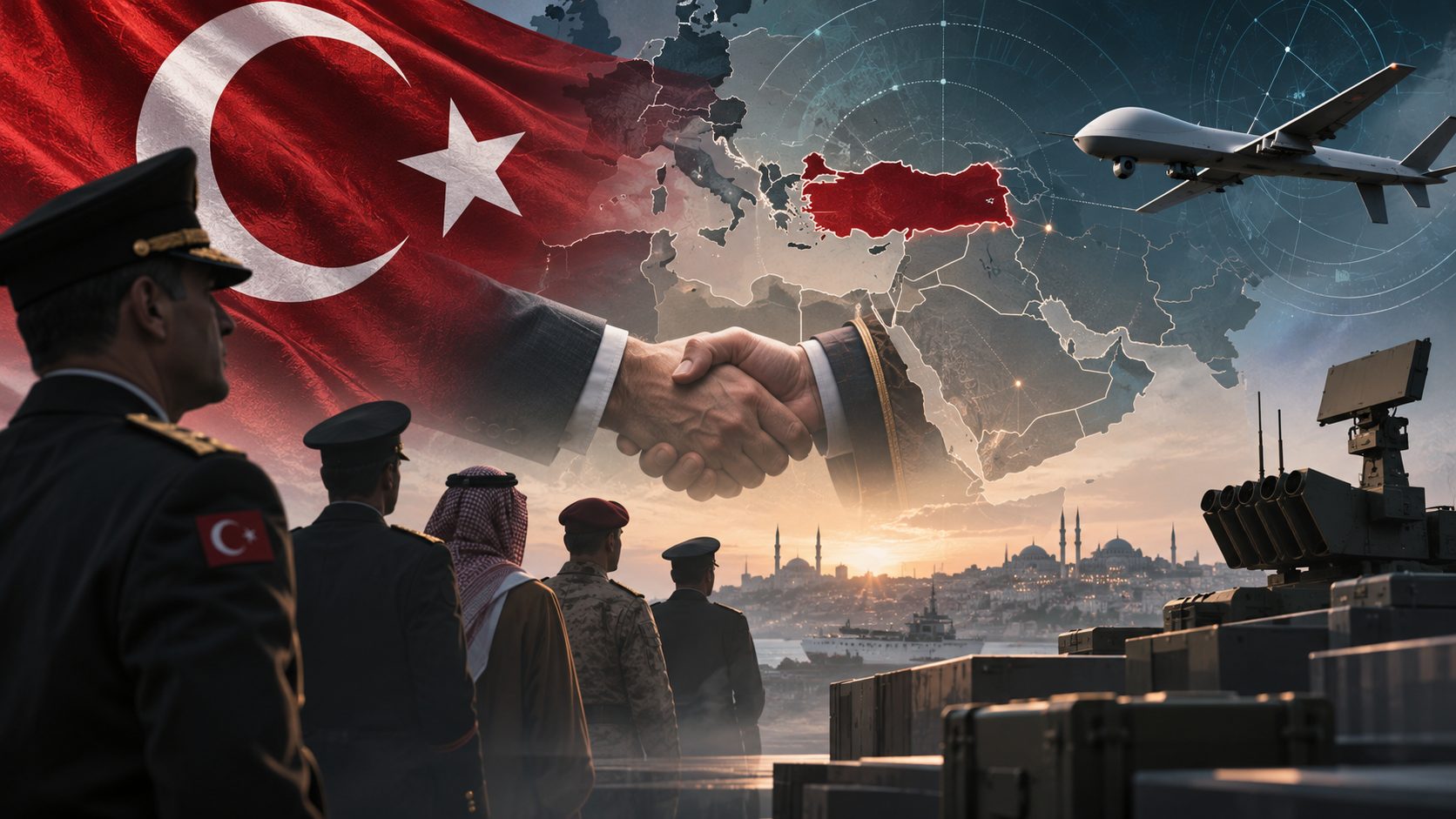
Zaviye Institute: Turkey’s defense pacts are less indicative of the formation of a cohesive military alliance than they are instruments for increasing political influence, expanding arms cooperation, and strengthening Ankara’s regional position.
Turkey’s growing participation in regional defense agreements should be viewed as part of Ankara’s efforts to increase its political influence, expand its arms markets, and strengthen its bargaining power in the Middle East—not necessarily as a sign of the formation of a powerful and cohesive military alliance. Developments in 2026, particularly the signing of the Mecca Defense Pact between Turkey, Saudi Arabia, and Pakistan on August 7 and the new Turkey-Qatar defense agreement on November 13, demonstrate Ankara’s interest in expanding its network of security cooperation. Despite these developments, there remains a considerable gap between the announcement of defense commitments and the establishment of joint operational mechanisms.
Turkey’s first objective is to consolidate its position as an influential actor in Middle Eastern security arrangements. Ankara is seeking to present itself as a complementary partner amid growing regional instability and Arab countries’ doubts about the reliability of relying entirely on U.S. security support. This policy does not mean replacing the United States with Turkey; rather, it is an effort to secure a greater share in regional decision-making. Turkey also wants to demonstrate that NATO membership does not prevent it from pursuing independent cooperation with non-Western powers.
The second objective is to derive economic and industrial benefits from defense cooperation. Turkey’s defense industries have become one of the country’s important foreign-policy instruments in recent years. Cooperation with Saudi Arabia, Qatar, and Pakistan could expand opportunities for the sale of drones, air-defense systems, and electronic equipment, as well as for technology transfer. From this perspective, the value of industrial contracts and joint projects may be greater for Ankara than the pacts’ military commitments. The Polish Centre for Eastern Studies has also emphasized the link between Turkey’s regional diplomacy and its economic objectives and defense exports.
The third objective is to increase strategic flexibility in dealing with regional rivalries. While maintaining relations with Arab countries, Turkey has no desire to become trapped in a rigid and costly confrontation against Iran. Economic interdependence, geographical proximity, and concerns about the spillover of conflicts encourage Ankara to preserve channels of communication with Tehran. Accordingly, the new defense agreements are primarily instruments for managing balances and expanding diplomatic options, rather than a prelude to Turkey’s entry into direct confrontation with regional powers.
In this context, although the Mecca Pact entails a collective-defense commitment in legal terms, its operational significance should not be exaggerated. Differences in the three members’ security interests, the lack of joint operational experience under the pact, and the need for independent domestic decision-making complicate the implementation of its commitments. Even ratification of the agreement by the Turkish parliament does not mean the automatic deployment of troops; such action requires separate authorization. Accordingly, in its current form, the Mecca Pact is primarily political, symbolic, and declaratory in its deterrent function, although it also has the potential to generate specific forms of technical and intelligence cooperation.
Ankara’s fourth objective is to strengthen its position in relations with the West. Expanding defense cooperation with regional countries could enable Turkey to emphasize the importance of its geopolitical position and independent capabilities in negotiations with the United States and Europe. Nevertheless, the Turkish military’s structural dependence on NATO standards and infrastructure imposes real constraints on the formation of entirely independent security arrangements.
The new Turkey-Qatar defense agreement is also more a continuation of the two countries’ longstanding cooperation than the beginning of a fundamental transformation. The existence of established military relations between Ankara and Doha means that the new agreement’s added value will largely lie in expanding political coordination, military exercises, and industrial cooperation. The Badr Memorandum between Turkey, Qatar, Pakistan, and Indonesia likewise focuses on developing indigenous defense capabilities and should not be equated with an operational military alliance.
Ultimately, Turkey’s policy can be assessed as a form of low-cost, multilateral security networking. Through participation in various agreements, Ankara creates new economic and diplomatic opportunities while maintaining diversified relations, without necessarily seeking to assume the heavy costs of collective defense. The success of this policy depends less on the number of signed pacts than on the tangible results of the cooperation. Therefore, for the time being, the Mecca Pact and similar agreements are less a force reshaping the region’s military balance than a reflection of Turkey’s efforts to increase its influence, diversify its partnerships, and consolidate its role in the future configuration of the Middle East.
Reader comments