
The Securitization of the Caspian and the Shifting Balance of Power in Eurasia
The Caspian Sea on the Brink of War: Proxy Conflicts and Power Competition
 F
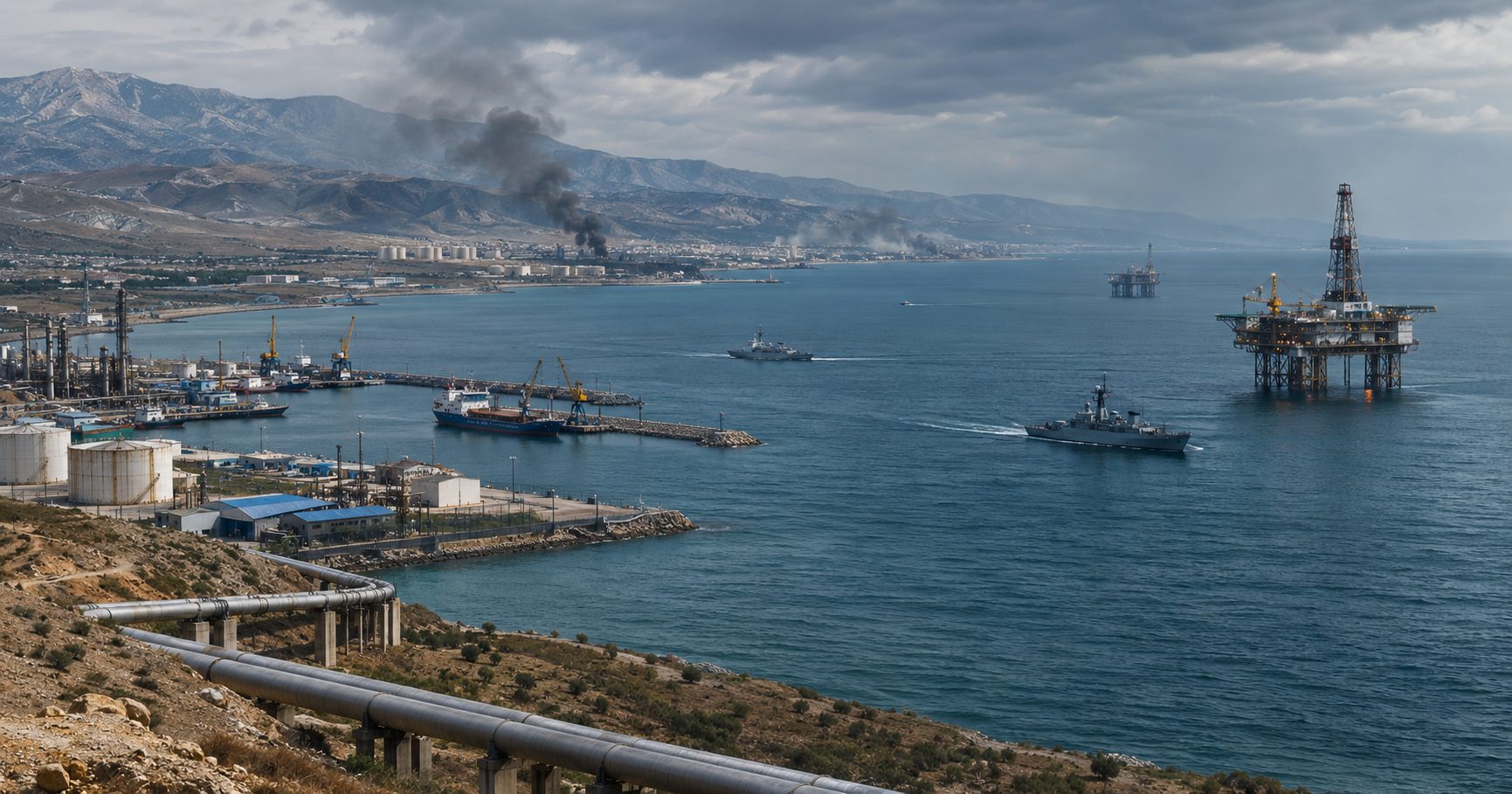
Zaviye Institute – Exclusive Translation: While much of the world’s attention is focused on the war in the Persian Gulf and the crisis surrounding the Strait of Hormuz, another vital strategic area—the Caspian Sea—is gradually becoming a new arena of geopolitical competition. As a safe haven, the Caspian Sea has been highly significant to its littoral states in terms of energy, trade and logistics.
Since the collapse of the Soviet Union, these states have agreed to prevent the presence of armed forces from non-littoral states, thereby ensuring regional independence and stability. This framework enabled countries such as Azerbaijan, Turkmenistan and Kazakhstan to advance ambitious maritime infrastructure and transport projects along the basin, strengthen the transit route of the Middle Corridor and position the Caspian Sea as a hub of Eurasian connectivity.
Read more: The Caspian, America’s New Arena of Confrontation to Control Energy Corridors
Securitization of the Caspian Sea
Recent developments in Caspian Sea security have long-term implications extending beyond the region. Against the backdrop of two major conflicts—the Russia-Ukraine war and the conflict between the United States and Iran—this maritime domain has faced unprecedented challenges. In 2025, Ukrainian drones attacked Russia’s Filanovsky oil platform, marking the first attack of its kind in the Caspian Sea. Several months later, in March 2026, Israeli missiles targeted Iran’s maritime assets at the port of Anzali, drawing strong criticism from the other littoral states. These incidents led to renewed Ukrainian drone attacks on Iranian positions, prompting a sharp reaction from Tehran.
From Kyiv’s perspective, attacking its military assets is justifiable because of Tehran’s proximity to Moscow. From Tehran’s perspective, however, these Western-backed actions are viewed as deliberate efforts to erode its capabilities and reduce its influence in the Caspian Sea.
As the geography of the Russia-Ukraine war shifts and the conflict between the United States and Iran continues, the Caspian Sea domain is at risk of becoming a new theatre of intensive military operations. Such a development would undermine the region’s critical energy infrastructure and disrupt east-west trade corridors. For the main regional actors, particularly Iran and Russia, the Caspian Sea has traditionally occupied a secondary position compared with the Persian Gulf or the Black Sea. This relative neglect stems from the fact that the Caspian has posed fewer security challenges, largely because of the decades-old consensus among the littoral states prohibiting the presence of extraregional powers in the Caspian Sea.
Nevertheless, the situation changed fundamentally, and in March 2026, Israeli fighter jets conducted long-range air operations targeting Iranian vessels and naval facilities in the Caspian Sea. The attacks damaged Iranian missile boats, as well as coastal maritime infrastructure around the port of Anzali, thereby complicating security issues in the domain for the other regional states—namely Azerbaijan, Kazakhstan and Turkmenistan.
Read more: The New Crisis in the Caspian Sea amid the US-Israeli War against Iran
The Middle Corridor and the Caspian’s Geoeconomics
Over the past decade, the aforementioned countries have made substantial investments in building maritime and energy infrastructure in the Caspian Sea and have strengthened the development of the transit route known as the “Middle Corridor.” Extending from China through Central Asia and the Caucasus and then to Turkey, this corridor preserves historic east-west trade links while also providing a viable alternative route. Although these countries have prioritised energy and trade partnerships through the Caspian basin, strengthened their navies and manoeuvred between East and West, this same domain has simultaneously become a strategic platform for the Iran-Russia axis amid recent conflicts.
For Russia and Iran, the Caspian Sea route not only facilitates cooperation in the energy sector and trade flows, but also enables the movement of technologies and materials related to sustaining the wartime economies of both countries, such as drone components and dual-use technologies. Therefore, from the perspective of the Russia-Iran axis, the Caspian Sea route functions as a vital node in the resilience architecture underpinning long-term strategic convergence between the two countries. Nevertheless, both sides are concerned that over the past five years the long-term balance of power has been shifting away from Tehran and Moscow, as the other littoral states have launched extensive efforts to rebuild their fleets to counter potential threats and protect their strategic assets.
Recent attacks by Ukraine’s long-range drones against Russia’s military-industrial enterprises, oil refineries, fuel and lubricant depots, and transport vessels have exposed the limitations of Moscow’s maritime power and its declining regional influence. A similar vulnerability was observed in Iran’s inability to protect its maritime assets during the latest wave of Ukrainian drone attacks. Thus, the Caspian Sea’s historical status as a “safe haven” for the Moscow–Tehran axis has been called into question.
In response, Iran and Russia will likely intensify efforts to prevent future Ukrainian drone attacks on maritime infrastructure and increase the delivery of military components via the Caspian Sea route. Although Russia places a high value on this cooperation, Iran currently has limited capacity to deliver significant quantities of weapons.
In fact, evolving geopolitical dynamics across Eurasia, together with security gaps, have compelled non-regional actors such as Ukraine and Israel to bring the Caspian Sea region into the theater of war. The prospect of the conflict spilling over into the Caspian Sea region and its littoral states has encouraged regional actors to pursue extensive modernization of their naval forces and air defense systems, invest in advanced technologies, and simultaneously seek new alliances such as the emerging Azerbaijan–Kazakhstan partnership.
A New Security Architecture
In recent years, security in the Caspian Sea region has become a primary concern for nearly all littoral states, driven largely by the need to protect trade routes. The rapid expansion of the Middle Corridor and the development of critical maritime infrastructure along this axis, which is highly vulnerable to potential air attacks, underscore the need to ensure its protection. As a result, there is a growing recognition that the resilience and capacity of the land routes underpinning this transit corridor must be strengthened to ensure its long-term security. Given the ongoing disruption of global supply chains due to continuing conflicts in Europe and the Middle East, any disruption to the Middle Corridor would have grave consequences for both Western countries and landlocked Central Asian states.
Recently, Azerbaijan, Türkiye and Kazakhstan introduced a new cooperation framework aimed at enhancing coordination in joint military exercises, naval drills and air defense systems. For example, in 2023, joint tactical naval exercises were held in the Azerbaijani sector of the Caspian Sea between the Azerbaijani and Kazakh navies near Baku. These exercises laid the foundations for a new interregional security format and also highlighted the importance of regional alliances among “middle powers” such as Azerbaijan and Kazakhstan in maintaining stability in the Caspian Sea.
Beyond bilateral formats, the parties have also established a constructive framework within the Organization of Turkic States (OTS), which not only deepens military cooperation but also paves the way for expanded economic and trade relations among member states, thereby enhancing the strategic role of the Middle Corridor route.
The importance of the Middle Corridor has once again been amplified, particularly in light of the peace process between Azerbaijan and Armenia and ongoing efforts to launch the “Trump Route for International Peace and Prosperity” (TRIPP). This route serves as a key component of commercial transit through Georgia and its Black Sea ports and will significantly enhance connectivity between the South Caucasus and Central Asia.
However, the corridor’s multimodal nature, combining railways, highways and maritime routes, makes ensuring its comprehensive security more complex. Despite all the coordination mechanisms and joint regional initiatives, uncertainty remains over how Iran and Russia will respond to the gradual development of the Middle Corridor, particularly the TRIPP project in the Caspian Sea region.
Reader comments