
Power Competition in the Caucasus
South Caucasus Developments: The Beginning of a New Order
 M
Zaviye Institute: Developments in Turkey–Armenia relations over the past several months constitute one of the important developments in the South Caucasus. What is unfolding today in relations between Ankara and Yerevan is indicative of the gradual reconfiguration of the regional geopolitical order that, over the past three decades, had taken shape around the Karabakh conflict, Russia’s balance of power, and competition over transport routes.
Armenia is transitioning from a foreign policy reliant on historical memory and Russia’s security guarantees to a pragmatic approach that prioritises preserving sovereignty, overcoming economic isolation, and diversifying its foreign partners.
Read more: Why Is Armenia Seeking to Normalise Relations with Turkey?
Developments in the South Caucasus and the Shift in Armenia’s Strategy
The first component of this transformation is the change in Yerevan’s calculations following developments in Karabakh. The weakening of Russia’s deterrent role and the shift in the military balance in favour of the Republic of Azerbaijan have confronted Armenia with the need to redefine the concept of national security. The Pashinyan government has recognised that continuing the historical confrontation with Turkey and Azerbaijan, without effective security backing, could intensify the country’s economic and political vulnerability. It has therefore placed the normalisation of relations with Ankara on its agenda and is pursuing it seriously—an issue that, rather than reflecting a change in historical attitudes, is a response to the new imperatives of state survival and the preservation of territorial integrity.
Against this backdrop, the issue of Mount Ararat has acquired significance beyond that of a merely symbolic dispute. The removal of the image of Ararat from Armenia’s entry and exit stamps can be interpreted within the framework of the government’s effort to separate historical identity from the territory of political sovereignty. Nevertheless, reducing this measure to a retreat in the face of Turkey does not explain all of its dimensions. Pashinyan is seeking to replace a territorial conception based on historical memories with the notion of “Real Armenia”—an approach that, from the government’s perspective, helps reduce its neighbours’ suspicions, but which opponents regard as a threat to collective memory and national identity.
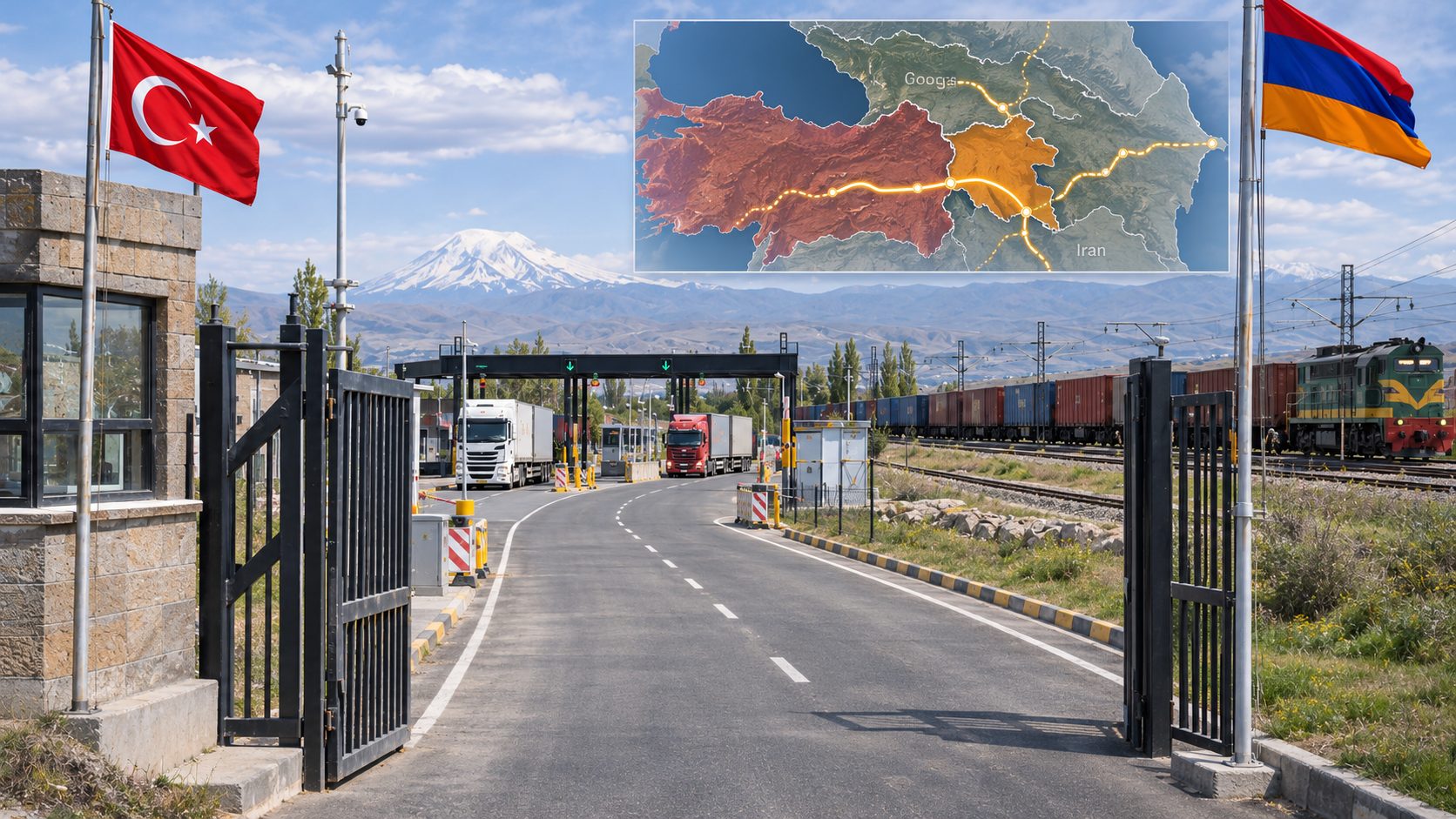
The second component within the framework of developments in the South Caucasus is the transformation of the geography of conflict into a geography of connectivity. The possible revival of the Kars–Gyumri railway, the opening of the Turkey–Armenia border, and the development of transport routes through Syunik could transform the region’s trade and transit structure. Nevertheless, a distinction must be made between political agreements, infrastructure preparation, and operational use. The success of these projects depends on legal arrangements, security guarantees, investment, and agreement on the exercise of sovereignty over transit routes.
Read more: The Syunik Corridor: Iran’s New Challenge
For Turkey, expanding connectivity with Armenia offers Ankara an opportunity to strengthen its position in the Middle Corridor and deepen its links with the Caspian region and Central Asia. The Republic of Azerbaijan also regards a reliable connection to Nakhchivan as one of its strategic objectives. Armenia, by contrast, hopes that by becoming part of the regional transit network, it can reduce its economic and security dependence and utilise its geographical position as an instrument of development.
The Implications of the New South Caucasus Order for Iran
Nevertheless, the implications of this reconfiguration for Iran are more complex. Tehran benefits from reduced tensions and the expansion of economic connectivity in the South Caucasus, but it is sensitive to any arrangements that affect Armenia’s sovereignty over Syunik, Iran’s access to its northern borders, or the region’s geopolitical balance. The increasing role of Turkey and the United States in designing transport routes could also affect Iran’s transit position. Accordingly, the fundamental issue for Tehran is not opposition to the principle of regional connectivity, but rather ensuring the territorial sovereignty of states, preventing the monopolisation of routes, and preserving the possibility of economic participation for all actors.
Further reading: Iran–Armenia Strategic Partnership: Opportunities and Security Red Lines
Russia, too, faces a structural challenge. The reduction of Moscow’s exclusive role in Armenia’s security arrangements indicates that the post-Soviet order in the South Caucasus is changing. Nevertheless, Armenia’s continuing economic, energy, and infrastructural dependence on Russia makes it impossible to interpret this transformation as the complete elimination of Moscow’s influence. In reality, the South Caucasus is moving more towards multilateral competition among powers than towards the complete replacement of one power by another.
Ultimately, the future of the regional order will depend not merely on the reopening of borders, but on the ability of the actors to transform fragile agreements into durable mechanisms of cooperation. Peace will be consolidated when mutual economic interests, respect for national sovereignty, and security guarantees prevail over identity-based and territorial rivalries.
In short, the South Caucasus is moving from the geopolitics of conflict to the geopolitics of connectivity; however, the sustainability of this transition requires economic corridors to become instruments of regional cooperation, rather than new levers for exerting pressure and reproducing great-power rivalry.
Reader comments