
South Caucasus Geoeconomics
Nakhchivan’s Foreign Trade: Iran’s Strategic Imperatives in the Zangezur Scenario
 D
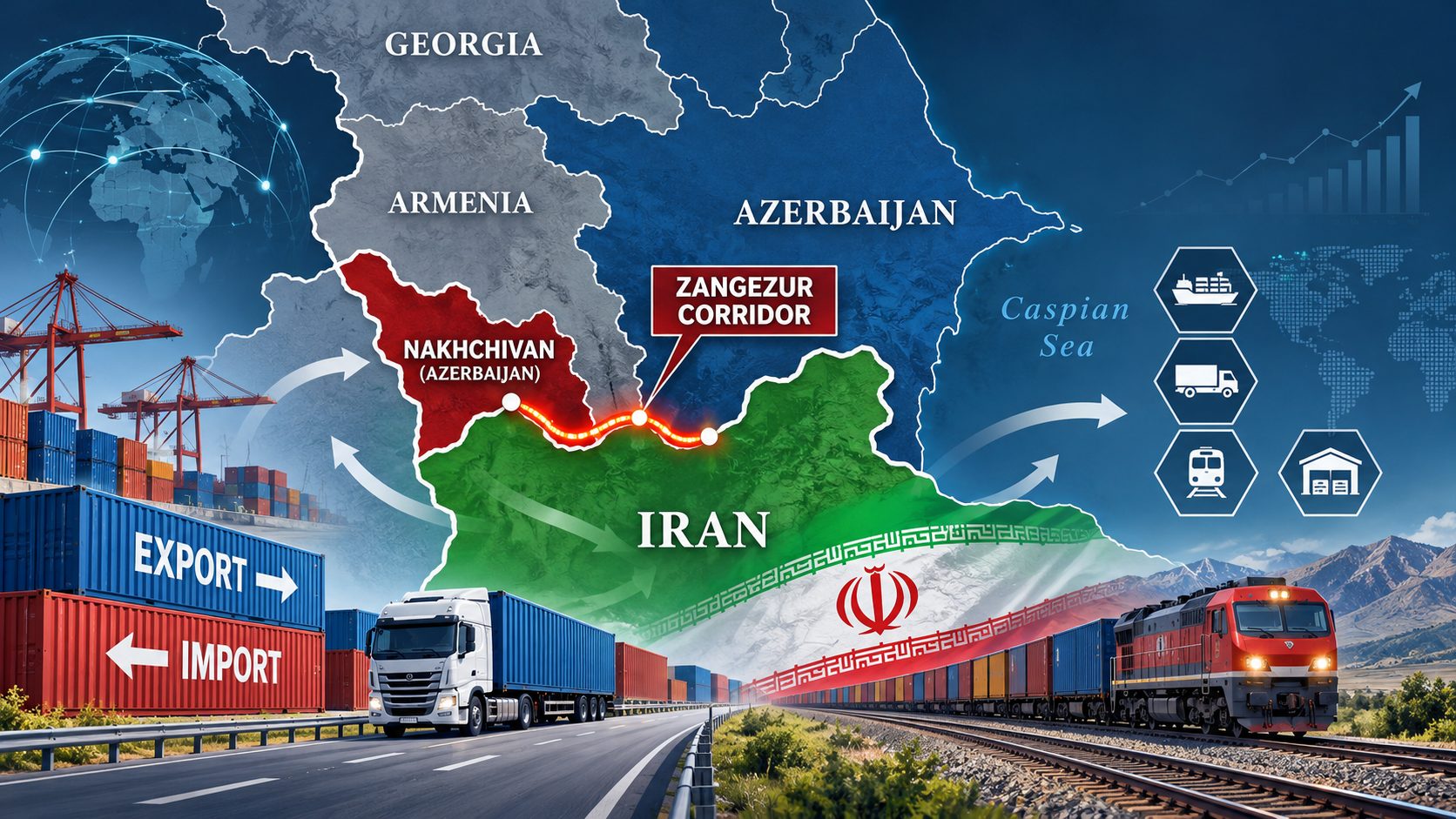
Zaviye Institute: The five-month and first-half 2026 statistics released by the Nakhchivan State Committee of Statistics present a picture of an “enclosed but developing” economy. The region’s total foreign trade has reached $70.5 million, accompanied by double-digit growth in exports (23 percent) and imports (20 percent). Despite this growth, Nakhchivan’s trade deficit indicates a heavy dependence on imports of machinery and infrastructure equipment. At present, Nakhchivan’s trade landscape is dominated by three main actors: Turkey, with a 55 percent share; Iran, with approximately 34.5 percent; and the Russia and Commonwealth of Independent States (CIS) bloc, with a 12 percent share. This note argues that although the “Zangezur Corridor” poses a threat to Iran’s corridor monopoly, by implementing an “Aras Corridor” strategy and “consolidating interdependence in the energy sector,” Iran can still preserve its strategic advantage.
Dissecting the Current Situation: The Three Sides of Nakhchivan’s Trade
Nakhchivan’s foreign trade structure is asymmetrically divided among three regional powers. As the leading trading partner, Turkey, which commands 55 percent of the market, serves as the principal supplier of industrial machinery, electrical equipment and textile raw materials, while absorbing Nakhchivan’s mineral stones and mineral water. On the second side, the Islamic Republic of Iran, with a share of approximately 34.5 percent, is not only a supplier of construction materials and petrochemical products but also, as a logistical facilitator, constitutes Nakhchivan’s vital lifeline. The third side—Russia and the CIS—with a 12 percent share, is the main destination for Nakhchivan’s agricultural products (potatoes, onions and fruit concentrate) and a supplier of strategic goods such as grain, timber and medical equipment. Of particular significance is the fact that 100 percent of trade between the third side (Russia and the CIS) and Nakhchivan passes entirely through Iran’s rail and road routes, placing Iran in the position of “overseeing Nakhchivan’s economic lifeline.”
The Zangezur Challenge: From Geographical Monopoly to Logistical Competition
The plan to launch the Zangezur Corridor (a land route through southern Armenia) represents the principal fault line in the geo-economic architecture of the South Caucasus. The realization of this route would pose three major threats to Iran: first, excluding Iran from the transit chain for trade between Russia and the CIS and Nakhchivan, thereby depriving Tehran of its leverage over food security and vital inputs. Second, increasing the maneuvering power of Turkish companies owing to economies of scale resulting from direct access to the Caspian Sea, which could challenge Iran’s current market share in Nakhchivan. Third, diminishing the strategic importance of the Bilasuvar and Julfa border routes for connecting Baku to Nakhchivan. Nevertheless, Iran must not fall into the trap of “exaggerating the rival.” Zangezur faces structural challenges, including difficult mountainous topography, the high costs of railway reconstruction, and uncertainty over the mechanisms governing security and customs controls, all of which cast doubt on its full and secure operation in the short and medium term.
Read more: The Zangezur Corridor: Iran’s Strategic Test in the South Caucasus
Counterstrategy: Turning a Threat into a Balance
To address the Zangezur scenario, Iran should not rely on passive policies. Iran’s strategic imperatives can be defined along the following three axes:
- Pre-emptive completion of the Aras Corridor: The Aras route project (Aghband–Kalaleh–Julfa) must be completed with the highest priority. Because it passes through flat plains, this route has significantly lower final transportation costs than the mountainous routes through Armenia. Iran should make this corridor the “rational” option for traders by applying preferential tariffs and guaranteeing customs clearance within 12 hours.
- Shifting the playing field toward “swaps and energy”: Nakhchivan is critically dependent on Iranian gas and electricity. Iran should link energy-swap agreements to transit commitments while simultaneously implementing a “grain swap” model (delivery of Russian grain at northern ports and delivery of flour or the final product at the Nakhchivan border). This measure would tie Nakhchivan’s food security to Iran’s presence in the supply chain.
- Integrating value chains in the Aras Free Zone: Rather than competing with the new 10-year tax exemptions in Nakhchivan, companies based in the Aras Free Zone should implement a “joint production” model. This would involve sending raw and semi-finished materials from Aras to Nakhchivan for final assembly and re-export to CIS countries. This model would transform Iran from a mere “transit country” into a “shareholder in value added.”
Conclusion and Policy Recommendations
Statistics for 2026 clearly show that Nakhchivan cannot sustain a balanced existence without Iranian territory. The Zangezur Corridor is a tangible threat, but not necessarily the endgame. The Islamic Republic of Iran’s strategy must shift from “relying on positional monopoly” to “relying on logistical efficiency and economic interdependence.” Establishing a special rapid-response Aras task force, redesigning transit tariffs for the Commonwealth fleet, and strengthening simultaneous diplomacy with Yerevan and Baku constitute the main pillars of Iran’s resilience in this strategic region. In the geo-economy arena, geography is an asset, but “efficiency” determines the ultimate winner.
Reader comments