
The Geopolitical Challenges of Pan-Turkism and Identity Divisions in Ankara's Domestic and Foreign Policy
Ankara’s Turkish Nationalism: A Power-Building Project or the Beginning of Turkey’s Strategic Erosion?
 Z
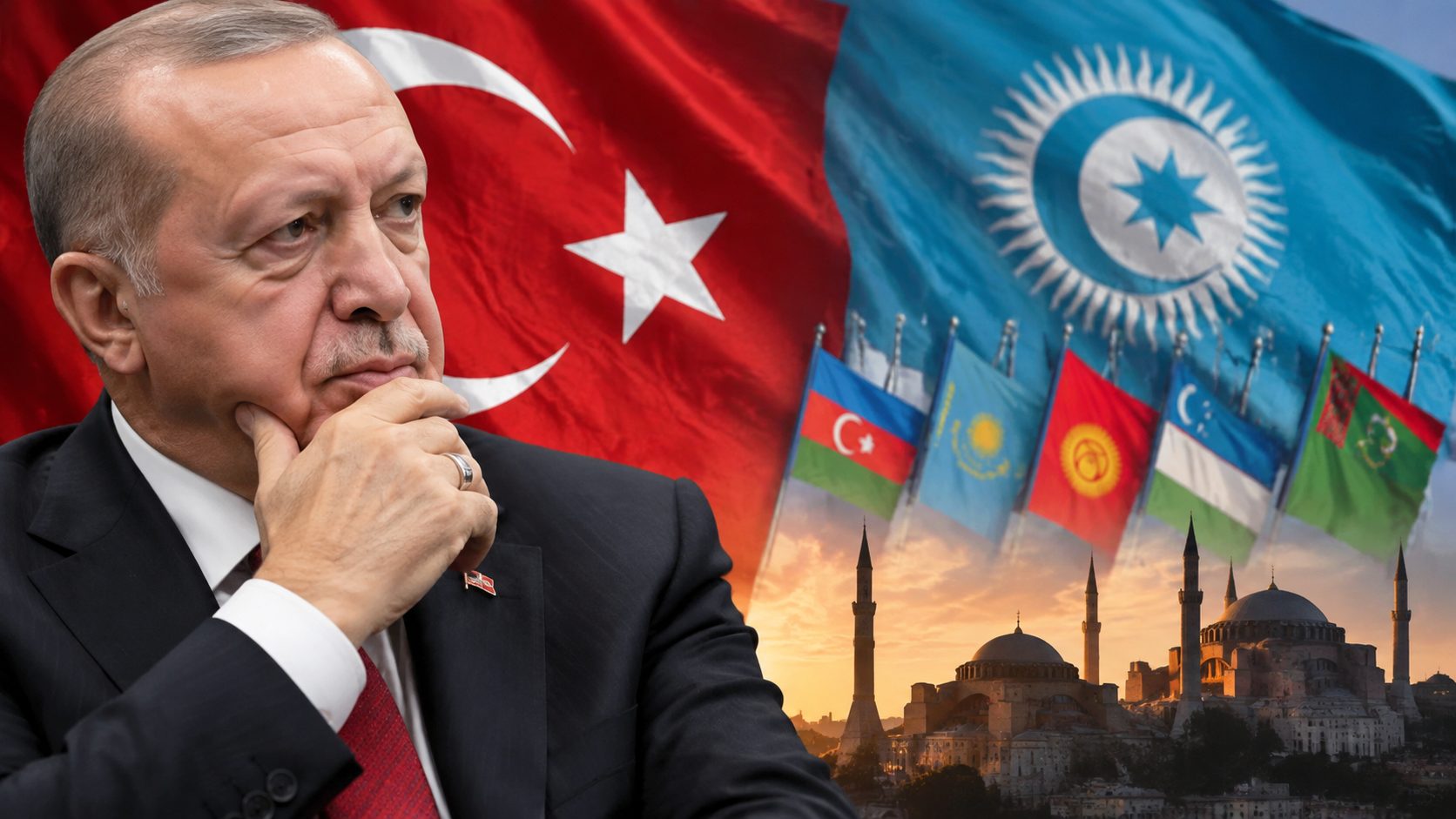
Zaviye Institute: The gradual dominance of ethnic and pan-Turkist nationalism over Turkey’s domestic and foreign policy, although it may provide Ankara with a new instrument for political mobilisation and the expansion of regional influence, nevertheless carries the long-term risk of weakening social cohesion, intensifying ethnic divisions, increasing friction with neighbouring states, and entangling Turkey in geopolitical ambitions beyond the country’s actual capacities.
Turkey’s political developments in recent years point to the growing prominence of an important component in the discourse of Recep Tayyip Erdoğan’s government: a shift from conservative Islamism and an emphasis on solidarity across the Muslim world towards a form of Turkish nationalism with pan-Turkist tendencies. This shift should be analysed in connection with Erdoğan’s political alliance with Devlet Bahçeli, leader of the Nationalist Movement Party, and Ankara’s efforts to turn the Organization of Turkic States into one of Turkey’s instruments of regional influence.
Turkish nationalism is, of course, not a new phenomenon; the main issue, however, is its transformation from an identity component into the dominant framework for policymaking and defining the national interest. The warning by Aydin Unal, a former adviser to Erdoğan and a figure close to Turkey’s conservative movement, about the danger of replacing Islamic unity with ethnic Turkic unity reflects the existence of disagreement within the ruling political camp over the consequences of this shift.
The following note briefly examines several important strategic consequences of Erdoğan’s Turkish nationalism:
۱. Intensification of ethnic divisions and the threat to domestic cohesion
The first negative consequence of the dominance of ethnic nationalism is the increased difficulty of managing Turkey’s social diversity. The country is not merely a society composed of Turks; Kurdish, Arab, Circassian, Alevi and other ethnic and religious groups are present within its social structure. Accordingly, defining national identity on the basis of the superiority or centrality of Turkish ethnicity could weaken sections of society’s sense of belonging to the national state.
This issue is particularly significant with regard to Turkey’s Kurds. At a time when Ankara has, since 2024, launched a renewed effort to end its decades-long conflict with the Kurdistan Workers’ Party (PKK), the strengthening of an extreme nationalist discourse could constrain the political space necessary for reconciliation and reform. Reports by Reuters and research institutes also indicate that mutual distrust, disputes over the political and cultural rights of Kurds, and electoral considerations remain among the main obstacles to this process.
In reality, Ankara cannot simultaneously seek to resolve the Kurdish issue and strengthen a discourse that may push some non-Turkish citizens to the margins in identity terms.
۲. The limits of the capacity to unite the Turkic world
The second consequence is a departure from the political realities of Turkic-speaking countries. Turkey may view itself as the natural centre of the Turkic world, but Azerbaijan, Kazakhstan, Uzbekistan and Kyrgyzstan each have independent national interests and security calculations.
A study published in 2026 in the journalTurkish Studies shows that although the member states of the Organization of Turkic States share an understanding of the importance of regional cooperation, their perceptions of the organization’s function differ: Turkey views it as a geopolitical actor, Azerbaijan emphasises its security capacities, and Kazakhstan pursues an essentially economic and pragmatic approach.
This divergence in approaches shows that linguistic and historical commonalities do not necessarily lead to strategic convergence. Even the recent disagreement between Ankara and Baku over the level of participation in the summit of Turkic states is an indication of the limits of the notion of Turkey’s unchallenged leadership. Consequently, turning pan-Turkism into the basis of foreign policy could create expectations whose fulfilment lies beyond Ankara’s control.
Read more: A Reflection on the Dimensions and Aspects of Ankara’s Policy of Establishing Greater Turkestan
۳. Increased friction with regional and extra-regional powers
The third consequence is the increase in the geopolitical costs of Turkey’s ambitions. The expansion of pan-Turkist influence in the South Caucasus and Central Asia, particularly in the security, military and transit spheres, could heighten the sensitivities of Russia, China and even some regional states.
Russia remains one of the important security and economic actors in Central Asia and the Caucasus, while China has extensive interests in the region’s connectivity routes through the Belt and Road Initiative. Therefore, Turkey’s effort to turn the Organization of Turkic States into a geopolitical bloc centred on Ankara could, rather than creating greater room for influence, lay the groundwork for costly competition with the great powers.
On the other hand, the Central Asian countries are not necessarily willing to make a strategic choice among Turkey, Russia and China. They generally prefer to use multilateral relations to preserve their political and economic independence. Under such circumstances, Ankara’s insistence on political and identity-based leadership of the Turkic world could backfire and reduce the confidence of its regional partners.
Read more: The Organization of Turkic States: Turkey and the United States’ Instrument in Central Asia
4. Eroding the Strategic Depth of the Islamic World
The fourth consequence is the narrowing of Turkey’s influence in the Islamic world. One of the historical advantages of Ankara’s foreign policy has been its ability to engage simultaneously with Turkic-speaking, Arab, Kurdish, Pakistani, African and Balkan communities. This capacity rests to a considerable extent on the historical legacy of the Ottoman Empire, religious ties, and cultural and economic networks.
However, the predominance of ethnic identity over civilizational identity could limit the scope of this influence. To play the role of an influential power in the Middle East and the Islamic world, Turkey needs social capital that extends beyond its ethnic borders. Emphasizing the ancestral ties among Turkic peoples may create appeal in Central Asia, but it does not necessarily possess the capacity to foster unity among Arab societies and other Muslim nations.
Of course, Islamic unity is not, in itself, a coherent political reality, and religious differences, regional rivalries and conflicts among the interests of states stand in the way of its realization. Nevertheless, setting aside this identity-based capacity in favor of Pan-Turkism could deprive Turkey of part of its cultural and political depth.
5. Becoming Trapped in the Gap Between Aspirations and National Capacity
The fifth consequence is the emergence of a gap between Turkey’s declared objectives and its actual capacities. Expanding influence in the Caucasus, Central Asia, the Middle East and Turkic-speaking regions requires economic resources, sustained investment, diplomatic capabilities and considerable military capacity.
While Turkey’s economy faces challenges such as inflation, currency pressures and the need for foreign investment, pursuing ambitious geopolitical objectives simultaneously could disperse the country’s resources. An April 2026 report by the MEI also emphasizes the connection between Turkey’s focused foreign policy and regional ambitions, on the one hand, and its economic constraints, sanctions pressures and the risk of overextending its military commitments, on the other.
Under such circumstances, turning Pan-Turkism into a transnational project could generate greater political and economic costs than the benefits it produces.
Conclusion
Overall, Turkey’s central problem is not cooperation with Turkic-speaking countries as such, but transforming this cooperation into an identity-based and hegemonic project. Ankara can use historical, linguistic and cultural commonalities to develop economic and security relations, but if it makes these commonalities the basis for defining a political hierarchy and claiming leadership of the Turkic world, it will face resistance from regional partners and the sensitivities of major powers.
From this perspective, Aydın Ünal’s warning should be taken very seriously and assessed as extending beyond an ideological disagreement between Islamists and nationalists; it reflects concern about Turkey’s strategic future. By forming an alliance with the nationalist movement, Erdoğan may acquire a more effective instrument for political mobilization and consolidating his power in the short term, but in the long term there is a risk that, rather than becoming an inclusive regional power, Turkey will become trapped within a narrower framework of ethnic, security and geopolitical rivalries.
In fact, Turkey’s strategic power lies in its ability to connect different geographies and create a network of shared interests, not in attempting to define a sphere of influence based solely on ethnicity. If Turkish nationalism does not become an instrument for balanced cooperation and instead develops in the form of expansionist Pan-Turkism, it may become a factor eroding Ankara’s social, diplomatic and economic capital rather than enhancing its national power.
Reader comments