
Ankara’s Eastern Strategy
Is the Zangezur Corridor Ankara’s Link to the Purported Turkic World?
 Z
Zaviye Institute: In his message to the International Caucasus Congress in Igdir on 3 Azar 1405 (24 November 2026), Turkish President Recep Tayyip Erdoğan, while referring to developments in Karabakh and the need for regional cooperation, described the opening of the so-called Zangezur corridor as a basis for strengthening transport infrastructure between the mainland of the Republic of Azerbaijan and Nakhchivan and creating new opportunities for Turkey’s engagement with the Turkic world.
The significance of Erdoğan’s remarks lies in the fact that he extends the function of the alleged Zangezur corridor beyond connecting two parts of the territory of the Republic of Azerbaijan and directly links it to Turkey’s relations with the Turkic world. This position, alongside Ankara’s institutional policies and infrastructure investments, indicates that Zangezur is not merely a transit project in Turkey’s regional strategy, but rather a link in a long-term plan for Turkey’s geographic and communications connectivity with the Turkic-speaking countries to its east.
Turkey’s Geographical Separation from the Turkic World
One of Turkey’s geopolitical constraints in advancing its policy of convergence with the Turkic world is the country’s geographical position relative to other Turkic-speaking countries. In contrast to Turkey’s historical orientation toward Europe and the West, the bulk of the Turkic world’s geographical, demographic and territorial potential lies in eastern Anatolia, the South Caucasus and Central Asia.
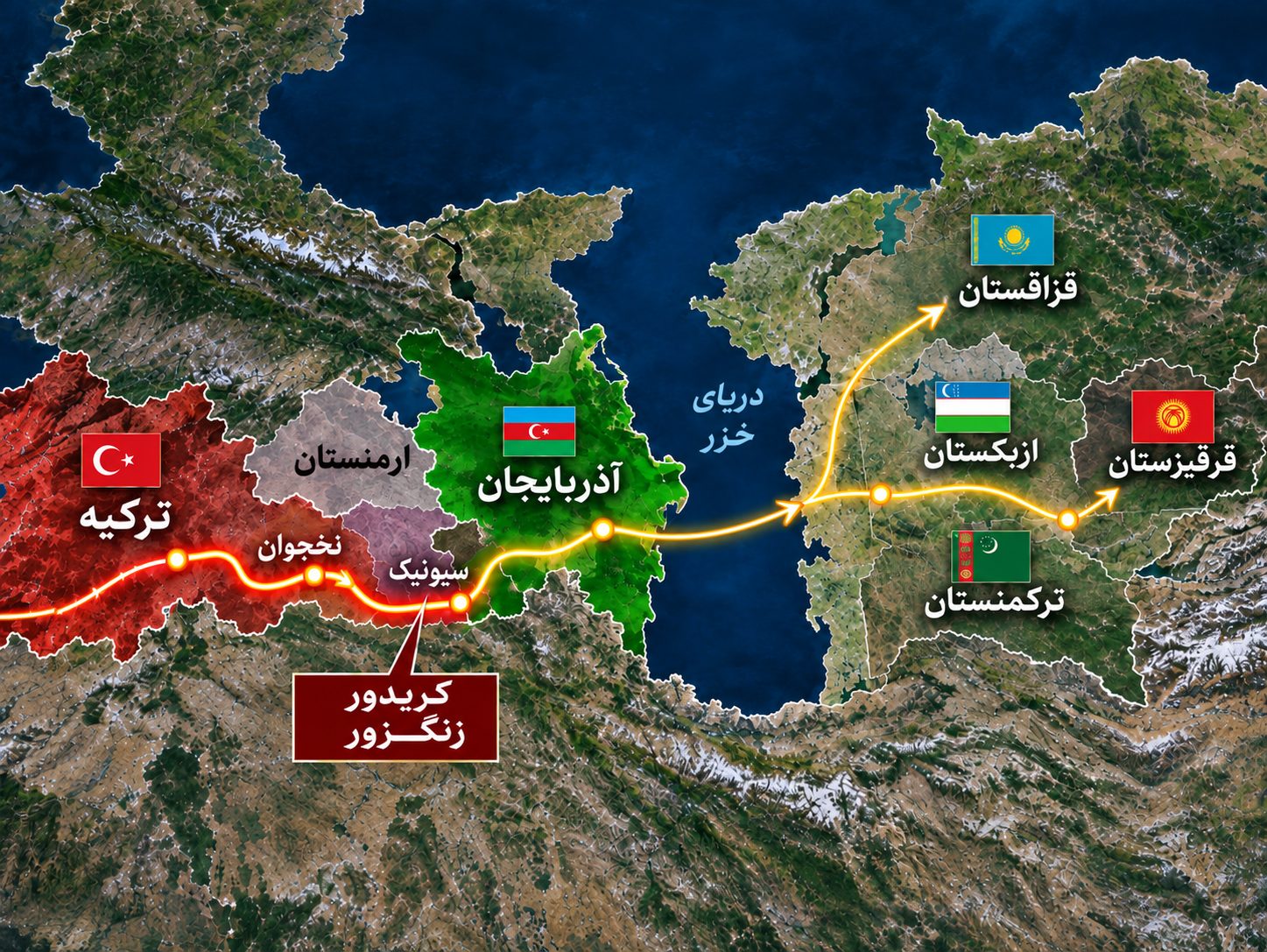
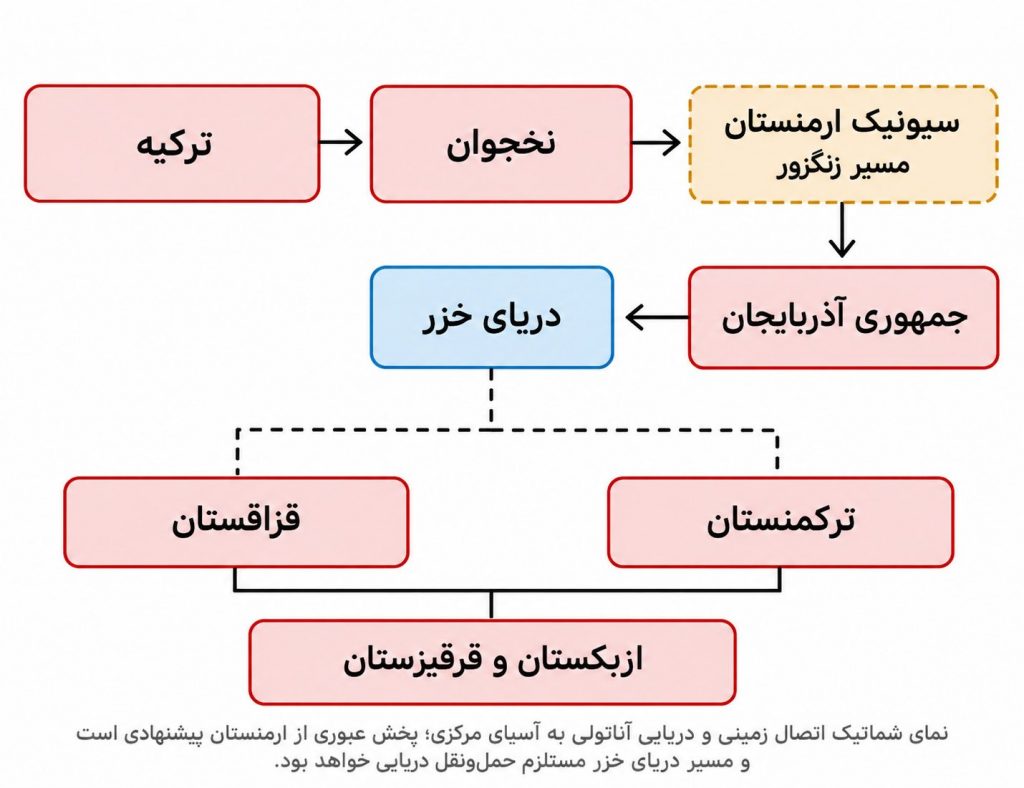
The Republic of Azerbaijan, Kazakhstan, Turkmenistan, Uzbekistan and Kyrgyzstan are all located east of Turkey. However, Armenia’s position between Nakhchivan and the mainland of the Republic of Azerbaijan, together with the Caspian Sea between the Caucasus and Central Asia, has prevented the formation of a fully continuous overland communications axis among these countries.
Turkey currently accesses the Republic of Azerbaijan through Georgia and the Baku–Tbilisi–Kars transport network; however, the opening of the Zangezur route could create a more direct and complementary axis through Nakhchivan and southern Armenia. From this perspective, Zangezur’s importance for Ankara lies in reducing the communications gap between Anatolia and the eastern part of the Turkic world.
The Zangezur Corridor: The Link Connecting the Turkic World
In recent years, Turkey’s policy toward Turkic-speaking countries has shifted from strengthening linguistic, cultural and historical commonalities toward political institution-building, economic convergence and the development of communications infrastructure.
The adoption of the Turkic World Vision 2040 document in 2021 and the adoption of the Organization of Turkic States’ Transport Connectivity Programme in 2022 demonstrate the importance of communications infrastructure in this process.
Moreover, the 13th Summit of the Organization of Turkic States, held in Ankara on 30 October 2026 with an emphasis on linguistic, intellectual and practical solidarity, highlighted the expansion of political coordination, economic cooperation, transport connectivity and cultural relations. At the summit, the organization’s rotating chairmanship was also transferred from the Republic of Azerbaijan to Turkey.
Within this framework, Zangezur can be regarded as the geographical link completing the policy of convergence across the Turkic world. Through the development of shared infrastructure, Ankara seeks to transform identity-based and cultural ties with Turkic-speaking countries into stable economic, communications and political relations.
From this perspective, Erdoğan’s explicit reference to the Turkic world in explaining Zangezur’s importance indicates the presence of an identity-based and ethno-linguistic component alongside the project’s economic and transit objectives; although this component does not mean that Turkey’s objectives are exclusively driven by ethnic motivations.
Read more: Turkey Seeks a “Turkic World Century”
Turkey’s Investment in the Zangezur Corridor
One of the most important practical indications of Turkey’s determination to establish a stable overland connection with the Republic of Azerbaijan and the Turkic world was the commencement of construction of the Kars–Igdir–Aralik–Dilucu railway on 22 August 2025.
According to official information from Turkey’s Ministry of Transport and Infrastructure, the 224-kilometre railway, financed through €2.4 billion in external funding, has been designed as part of the communications network associated with Zangezur. Once completed, the project will connect Turkey’s railway network to the Nakhchivan border.
Investment in such long-term infrastructure demonstrates that Turkey’s policy toward Zangezur has moved beyond political statements and entered the implementation phase. The construction of rail and road networks can facilitate the sustained movement of goods and passengers, increase economic interdependence and deepen social ties between Turkey and Turkic-speaking countries.
Moreover, the selection of the border city of Iğdır to host the International Caucasus Congress carries symbolic and geographical significance, given the city’s proximity to Iran, Armenia and Nakhchivan.
Redefining Turkey’s Position in Eurasian Geopolitics
Gaining a more direct communication route with the Republic of Azerbaijan through Nakhchivan will enhance Turkey’s capacity to play a role in the South Caucasus and Central Asia.
Zangezur could also serve as a complementary branch of the Middle Corridor, a route connecting China to Europe through Central Asia, the Caspian Sea, the Caucasus and Turkey. Turkey has previously participated in this corridor, and the opening of a new route could increase the capacity and diversify the communication routes available to it.
Accordingly, while strengthening ties with the Republic of Azerbaijan, Ankara would gain broader access to the markets and energy resources of Central Asia. Reduced dependence on certain routes passing through Iran, Russia and Georgia would also be among the potential consequences of diversifying Turkey’s transit network.
Within this framework, the Turkic world, in addition to its identity-based and cultural importance for Ankara, is becoming a platform for expanding Turkey’s geopolitical depth and strengthening its position in the Eurasian balance of power.
Read more: The Strategic Interests of the Republic of Azerbaijan and Turkey in the Zangezur Corridor
From the Zangezur Corridor to TRIPP: The Continuity of Ankara’s Strategy
The Washington Agreement of 8 August 2025 between the Republic of Azerbaijan and Armenia, and the creation of the project known as the Trump Route for International Peace and Prosperity, or TRIPP, have established a new framework for reopening communication routes in southern Armenia.
In 2026, with the development of an implementation framework and the conclusion of a strategic cooperation agreement between Armenia and the United States, the project entered its initial operational phases. Despite the legal and managerial differences between the concept of the purported Zangezur corridor and the TRIPP project, both concern a communication route between Nakhchivan and the mainland of the Republic of Azerbaijan.
Nevertheless, according to official documents published by the Ministry of Foreign Affairs of Armenia, implementation of the TRIPP project must take place with respect for the national sovereignty, territorial integrity and jurisdiction of the countries concerned.
Erdoğan’s recent statements indicate that, regardless of the project’s name and management framework, Ankara continues to regard strengthening connectivity with the Turkic world as one of the strategic objectives of opening this route. From this perspective, changing the project’s title does not necessarily signify a change in Turkey’s connectivity objectives.
Implications of the Zangezur Corridor for Iran
The creation of a stable communication axis linking Turkey, the Republic of Azerbaijan and Central Asia could affect Iran’s position as a transit hub and the regional balance of influence in the long term. As the capacity of alternative routes increases, the Republic of Azerbaijan and Turkey may become less dependent on certain routes passing through Iran.
Moreover, strengthening institutional and infrastructural ties among Turkic-speaking countries could increase Turkey’s capacity to play a role in Iran’s regional environment.
At the same time, a distinction must be made between reopening transit routes under Armenia’s sovereignty and creating a corridor outside that country’s sovereign jurisdiction. This distinction is particularly important for Iran in terms of preserving its shared border with Armenia, preventing changes to international borders and averting the emergence of security threats in the vicinity of the country’s northwestern borders.
Recent positions adopted by Iran’s diplomatic establishment also indicate that Tehran remains sensitive to preserving Armenia’s territorial integrity and preventing geopolitical changes that threaten Iran’s interests.
Conclusion
A simultaneous examination of Erdoğan’s statements, the geographical position of Turkic-speaking countries, the strategic documents of the Organization of Turkic States and Turkey’s infrastructure investments provides a documented basis for the assessment that Ankara is seeking, through Zangezur, to establish a stable land connection with the eastern part of the Turkic world.
In fact, within Turkey’s strategy, Zangezur could become the point where geopolitics and identity intersect—a route that enables linguistic, ethnic and cultural commonalities to be transformed into durable economic, communication and political ties. The objective inferable from the available evidence is to reduce Anatolia’s geographical separation from the Caucasus and Central Asia and strengthen Turkey’s central role in the process of Turkic-world integration.
From the perspective of the Islamic Republic of Iran, it is essential for the Ministry of Foreign Affairs, in cooperation with the Ministry of Roads and Urban Development, to place on its agenda the pursuit of legal and political guarantees for preserving Armenia’s sovereignty and international borders, the development of competing transit routes, the strengthening of economic cooperation with the countries of Central Asia and the enhancement of Iran’s connectivity advantages.
Reader comments