
The Caspian Sea and the North–South Corridor: The Achilles’ Heel of the Plan to Encircle Iran
Why Is America’s Iron Gate Doomed to Fail?
 D
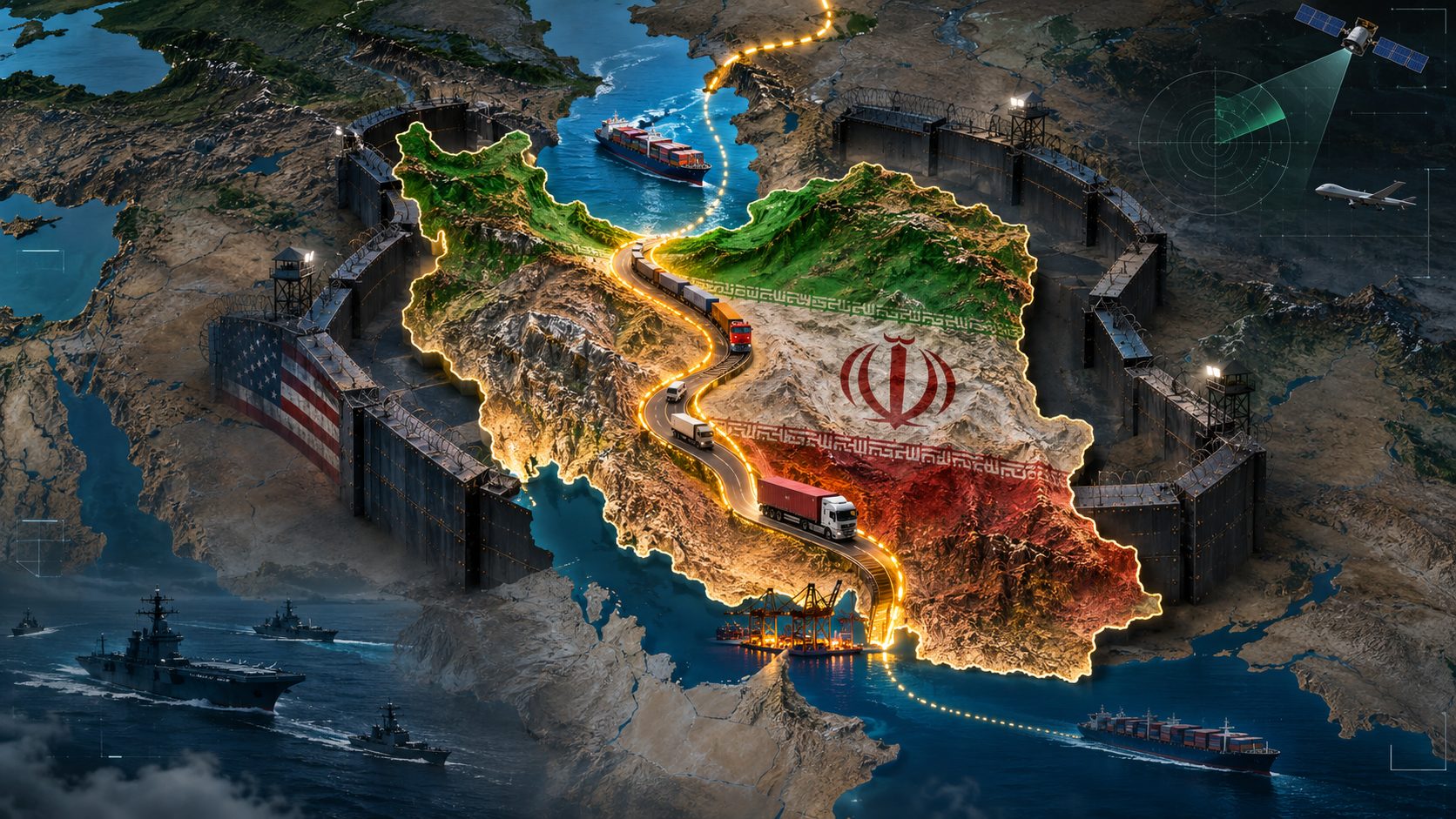
Zaviye Institute: On November 10, 2026, U.S. President Donald Trump announced that military operations against Iran had, in hardware terms, effectively come to an end. However, he stressed that the situation described as the “largest naval blockade in history” would remain in place, alongside the activities of the newly established “Iron Gate” task force.
Earlier, on November 7, 2026, U.S. Central Command, under the orders of Admiral Brad Cooper, had unveiled the formation of the Iron Gate special unit. The group is a centralized coordinating structure based in Tampa, Florida, comprising approximately 20 elite military and civilian specialists.
The body is tasked with continuously coordinating with the U.S. Departments of the Treasury, State and Justice, as well as U.S. intelligence agencies, to monitor and block the movement of advanced missile systems, dual-use items, sanctioned cargoes and informal revenue channels along Iran’s land borders and across the Caspian Sea. Admiral Cooper described the measure as an important step toward the success of the previous naval blockade, which, he claimed, had prevented oil exports worth more than $25 billion.
Why Is the Caspian Important?
According to U.S. officials, Iran has managed to meet part of its economic and military needs, particularly from Russia, through the Caspian Sea and the Caucasus countries. For example, according to data from the Institute for Agricultural Market Studies (IKAR), during the first four months of the 2026–27 agricultural season, Iran was the main buyer of Russian grain, importing 2.1 million tonnes.
Moreover, according to a claim by Reuters in late October 2026, a network affiliated with Iran’s Ministry of Defense had succeeded, since the beginning of 2025, in importing at least $2 billion worth of sensitive military cargoes, missile-propellant compounds, explosives and heavy trucks manufactured by companies such as Iveco and Toyota. These commercial and military exchanges continued even during the conflict, originating in Russia and passing through the Caspian Sea, Central Asian land borders and China’s air-transit corridors.
Pakistan’s authorization for the re-export of goods on April 25, 2026, and a supplementary report by the Center for Strategic and International Studies (CSIS) indicated that, as oversight of the southern Persian Gulf crossings tightened, corridors leading to Pakistan, Central Asia and the Caspian basin had assumed doubled importance for Tehran. Estimates by U.S. monitoring agencies indicate that these networks are primarily focused on procuring sensitive drone and missile components, including sodium perchlorate, titanium alloys, detonators and high explosives; heavy-vehicle chassis suitable for use as launchers; high-tech dual-use equipment; cryptocurrency-based financial mechanisms; and the direction of oil “shadow fleet” operations.
Washington’s Serious Challenge
According to experts, Iran shares 5,894 kilometers of land borders with seven countries: Iraq, Turkmenistan, Afghanistan, Pakistan, Azerbaijan, Turkey and Armenia. In addition, the Caspian Sea, shared by Iran, Russia, Azerbaijan, Kazakhstan and Turkmenistan, has effectively become, owing to the absence of Western monitoring instruments, a secure platform for the shipment of strategic components and equipment such as drone systems—one that will be extremely difficult for the United States to control unilaterally.
Moreover, neighboring countries’ cooperation with the Pentagon’s plan faces considerable uncertainty. For example, despite NATO commitments and concerns about U.S. sanctions, the substantial profits generated by cross-border trade are attractive to Ankara. Thus, daily truck traffic through the Bazargan border crossing increased sixfold, from 200 to 1,200 vehicles, in September 2026.
Read more: “Tabriz, Urmia and Ardabil: Iran’s Foreign Trade Boom Triangle under Sanctions and Blockade”
In this context, the Caspian basin, to which NATO and the United States have no direct access, has become a major gap in the containment plan. Iran’s bilateral and multilateral coordination with Russia and its northern neighbors is turning this waterway into one of the most reliable channels for circumventing pressure.
The Antidote to the North–South Corridor
According to experts, experience shows that obstructing a single passage merely causes the flow of goods to shift to more complex routes such as the Caspian Sea. Accordingly, the current confrontation will not be a contest over border lines, but rather a competition over logistical and financial networks.
In this context, the North–South Corridor is of considerable importance. For example, Russia’s ambassador to Iran stated that “despite the military conflict in the Middle East, trade exchanges between Moscow and Tehran are expanding and increased by 10 percent during the first eight months of the current year. The International North–South Transport Corridor is also significantly strengthening trade cooperation.”
Additionally, the Supreme National Security Council (SNSC) approved the agreement for the construction of the Rasht–Astara railway, advancing the completion of the missing link in the North–South Corridor. The Deputy Minister of Roads and Urban Development announced that “last Wednesday, the remaining 37 kilometres of land along the route of the Rasht–Astara railway (the remaining section of the INSTC) were handed over to the Russian company to carry out the necessary tests.”
Read more: Development of the North–South Corridor: Tehran and Moscow’s Eurasian Strategy
The volume of trade exchanges and transit cargo in the Caspian region, which has grown significantly in 2026, indicates that this waterway has become the Achilles’ heel of US maritime and intelligence sanctions, effectively allowing Iran to transport essential goods, permitted equipment and the parts it requires beyond Washington’s direct oversight.
Conclusion
Overall, the North–South Corridor (INSTC) effectively serves as Iran’s transit and geopolitical shield against the pressure exerted by the “Iron Gate” task force. While CENTCOM seeks to narrow the routes for the entry of goods through intelligence tools and the threat of sanctions, the simultaneous development of the North–South Corridor and the dependence of regional economies on this transport network prevent “Iron Gate” from achieving a complete physical blockade and inevitably reduce it to a limited and ineffective monitoring tool.
Reader comments