
The Political Economy of Transit in Eurasia
The Middle Corridor: Turkey’s $30 Billion Bet on Eurasian Trade
 M
Zaviye Institute: When the “Middle Corridor” is discussed, it is in fact one of Turkey’s most serious bets in the Eurasian geography; a route in which Ankara has invested politically and economically for years and which is now becoming more prominent than ever against the backdrop of the war in Ukraine and the deadlock affecting the northern and southern routes.
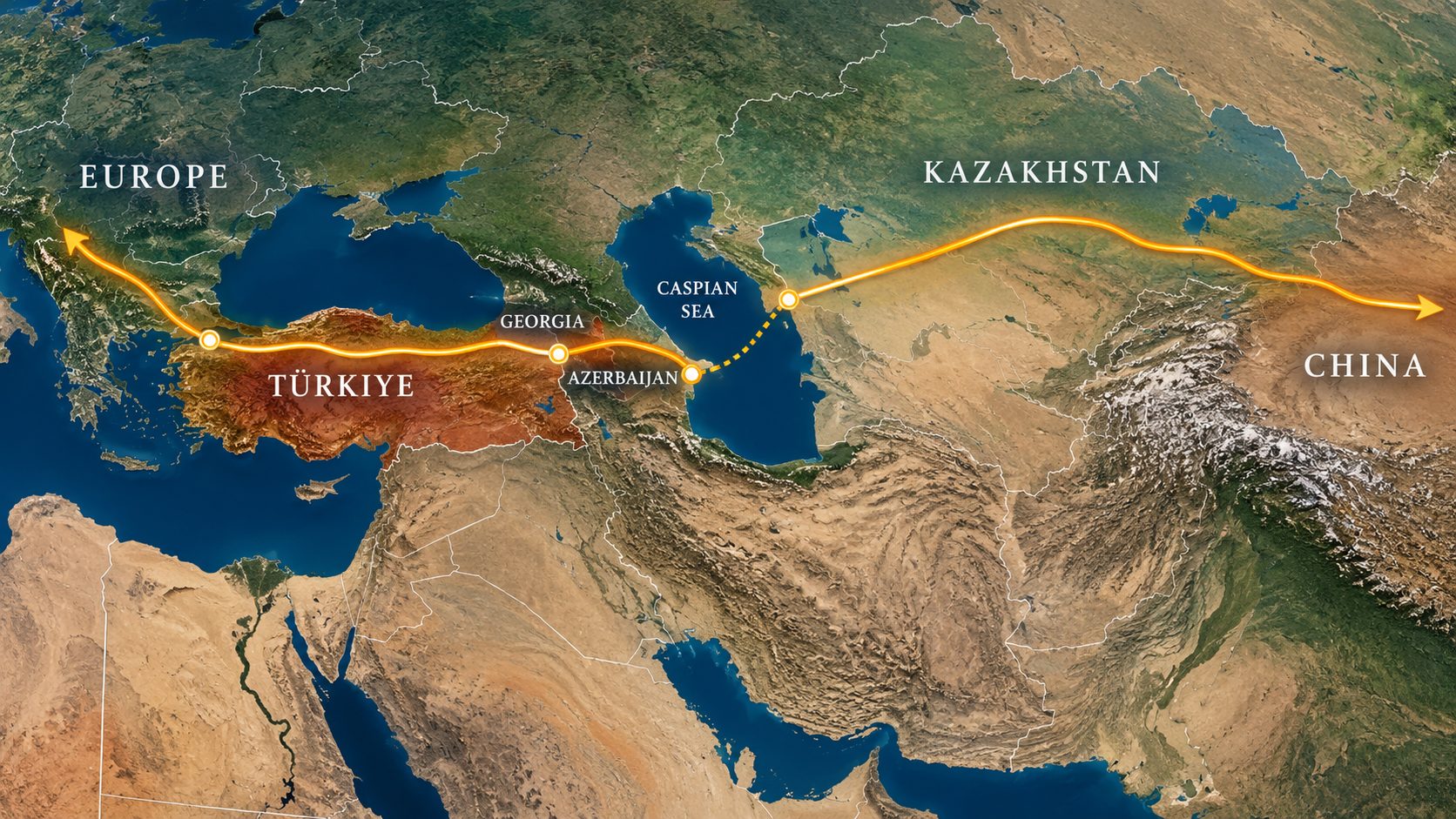
The Middle Corridor is a multimodal rail-and-road link connecting China to Europe via Kazakhstan, the Caspian Sea, Azerbaijan, Georgia and Turkey. The route is estimated to be approximately 6,500 to 7,000 kilometers long, and this very length is both an opportunity and a source of difficulty.
The Middle Corridor: The Figures Behind a Geopolitical Opportunity
Published statistics indicate that this route is becoming a more serious option in the Eurasian transport network. According to a report by the Organisation for Economic Co-operation and Development (OECD), the volume of goods transported through the Middle Corridor rose by 62 percent in 2024, reaching approximately 4.5 million tons, whereas the figure was around 2.8 million tons in 2023. This increase indicates growing demand for use of the Trans-Caspian route, although it should not be interpreted as meaning that the route has a capacity comparable to that of the Northern Corridor. By comparison, the volume transported through the Eurasian Northern Corridor in 2023 was reported at approximately 177.7 million tons. The Middle Corridor therefore still has a considerable gap to close with established routes.
World Bank projections shed further light on the long-term scale of this opportunity. According to the institution’s report in September 2026, targeted investment could more than triple the volume of transit trade passing through the corridor by 2040, and if infrastructure investment is accompanied by customs and operational reforms, this volume could even quadruple. The World Bank has also estimated that development of the route could increase the gross domestic product of the countries involved by 3.3 percent and create approximately 2 million new jobs. Realizing this outlook, however, will require substantial investment: at least $25 billion for core infrastructure and approximately another $30 billion for complementary infrastructure, logistics centers, connecting lines and transport equipment by 2040.
Read more: The Middle Corridor on the Verge of a Eurasian Transit Surge with a Threefold Increase in Capacity
A significant part of Turkey’s calculations is embedded in these figures. Ankara wants to use its position at the western end of the corridor as a link between Central Asia and the European market. The Baku–Tbilisi–Kars railway is one of the key components of this strategy. This approximately 850-kilometer railway connects Azerbaijan, Georgia and Turkey. Following the completion of reconstruction and expansion works on the Georgian section in 2024, its annual freight capacity increased from 1 million tons to 5 million tons. Meanwhile, the Port of Baku has an annual capacity to handle 15 million tons of cargo and 150,000 twenty-foot equivalent units (TEUs). These infrastructures show that the countries along the route are not merely seeking political agreements; they are also creating operational capacity to attract trade flows.
Turkey and the Conversion of Transit into Economic Influence
For Turkey, the central issue is not merely the passage of trains and trucks through its territory; it is attaining a position in which transport companies, port operators, distribution centers, insurance services, warehousing and regional trade become dependent on Turkey’s logistics network. In such a situation, Ankara can evolve from a country situated along a trade route into an actor that plays a decisive role in organizing and managing it.
Read more: Turkey’s Role in the Middle Corridor and the Limitations of Its Influence in Central Asia
This strategy is also linked to the objectives of the Organization of Turkic States. Kazakhstan, Azerbaijan, Uzbekistan and Kyrgyzstan need this route to gain more diversified access to global markets. From their perspective, the Middle Corridor not only reduces dependence on routes controlled by Russia, but also enables the expansion of trade with Turkey and Europe and the attraction of foreign investment. In this context, Turkey can draw on its linguistic, cultural and political ties with these countries to facilitate economic cooperation. For this reason, the development of the Middle Corridor should be viewed as part of Ankara’s effort to strengthen the economic ties of the Turkic world, rather than merely as a transport project.
Constraints Complicating Ankara’s Calculations
Despite these capacities, the Middle Corridor still faces obstacles that cannot be overcome merely by increasing investment. Transit across the Caspian Sea depends on coordination between the ports of Kazakhstan and Azerbaijan. Differences in railway standards, customs procedures, waiting times at borders, limitations in the cargo-vessel fleet, and a lack of coordination among transport operators also increase the cost and transit time of goods. The World Bank has explicitly emphasized that port bottlenecks, railway lines, and maritime connectivity, alongside weak institutional coordination, are among the main obstacles to the route’s competitiveness.
At the same time, Turkey cannot advance this project independently of the considerations of Russia, China, and the European Union. China is seeking to diversify its export routes, but it still has extensive interests in existing trade corridors. Despite the Northern Corridor’s reduced appeal following the war in Ukraine, Russia continues to enjoy considerable economic and political influence in Central Asia. The European Union, for its part, has demonstrated its interest in strengthening regional connectivity in Central Asia by allocating more than €10 billion under the Global Gateway initiative. The Middle Corridor is therefore not an exclusively Turkish project, but rather an arena where the interests of various actors intersect.
In this context, Iran’s position should not be overlooked. The development of the Middle Corridor could limit Iran’s share of some east–west trade, particularly if Turkey and its regional partners are able to develop alternative routes more rapidly, cost-effectively, and reliably. This situation does not necessarily mean that Iran’s transit potential will be eliminated, however. Connecting the Middle Corridor to north–south networks and leveraging Iran’s position in relation to the Persian Gulf and open waters could also create scope for complementary cooperation.
Conclusion
Overall, Turkey’s bet on the Middle Corridor should be viewed as an investment in the future of the country’s economic and geopolitical power. Ankara seeks to transform the cultural ties of the Turkic world into a network of economic interests, shared infrastructure, and mutual interdependencies. Nevertheless, the gap between the corridor’s potential and its actual performance remains significant. If coordination among the countries along the route, investment, and operational reforms are achieved, Turkey could secure a greater role in managing the flow of Eurasian trade. If, however, power competition, regional disputes, and infrastructure bottlenecks prevail over cooperation, the Middle Corridor will remain less a consolidated trade artery than a geopolitical opportunity still taking shape.
Reader comments