
From Energy Investment to Military Cooperation between Baku and Abu Dhabi
Azerbaijan-UAE Relations: A New Energy and Security Alliance in the South Caucasus
 D
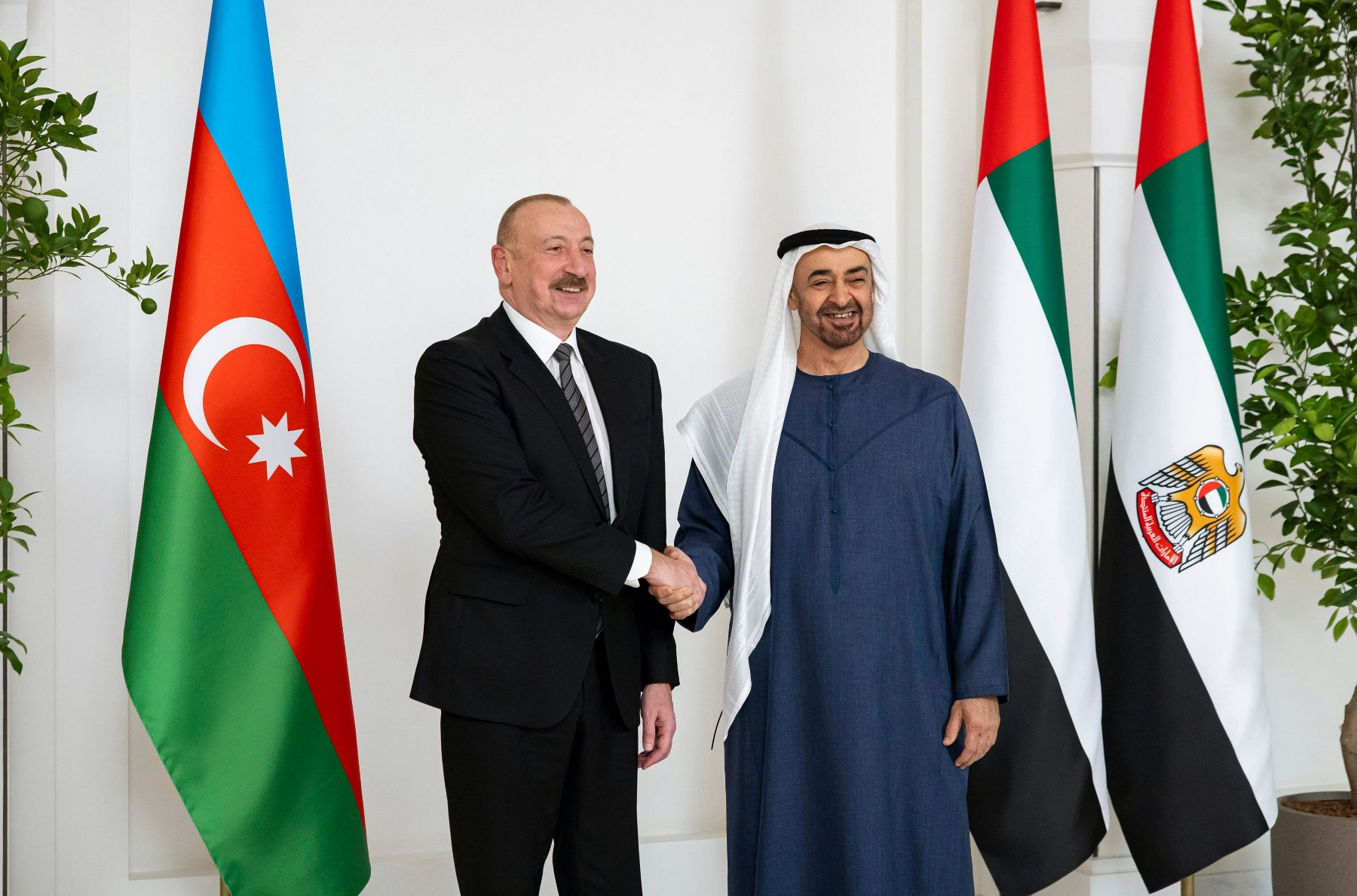
Zaviye Institute: Although relations between the Republic of Azerbaijan and the United Arab Emirates have been pursued at a high level in recent years, the nature of bilateral relations cannot be fully understood solely through the lens of political solidarity and diplomatic ties. More recently, bilateral relations have developed a broader strategic agenda and evolved into a multidimensional framework for cooperation encompassing investment, energy, renewable energy, transport, logistics, tourism, food security and other economic sectors. The growing frequency of high-level exchanges and stronger political dialogue have also been important indicators of this shift. Energy has played a prominent role in this cooperation.
The UAE’s Masdar: A Key Role
Energy cooperation between Azerbaijan and the United Arab Emirates has become one of the most dynamic and strategic dimensions of relations between the two countries in recent years. Alongside cooperation in conventional energy, the two countries have laid the foundations for long-term cooperation, particularly in renewable energy and the energy transition.
Read more: The UAE–Azerbaijan Economic Partnership: Prospects and Implications
Against this backdrop, Abu Dhabi-based Masdar, one of the UAE’s leading clean-energy companies, has been the main driver of this cooperation. The year 2020 (1398–1399) marked an important turning point in institutionalising Azerbaijan–UAE cooperation in renewable energy, when Azerbaijan’s Ministry of Energy and Masdar signed an implementation agreement for the development of renewable-energy pilot projects. Bilateral cooperation gained further momentum following this agreement.
In April 2021 (Farvardin–Ordibehesht 1400), an investment agreement, a power purchase agreement and a grid-connection agreement were signed for the development of a 230-megawatt solar power plant in Azerbaijan. In March 2022 (Esfand 1400–Farvardin 1401), the foundation stone was laid for the 230-megawatt Garadagh Solar Power Plant, which was inaugurated on 26 October 2023 (4 Aban 1402). The plant was developed with $262 million in foreign investment and was Azerbaijan’s first utility-scale solar-energy project developed through foreign investment.
In October 2023 (Mehr–Aban 1402), investment agreements were signed with Masdar for the implementation of three new projects with a combined capacity of 1,000 megawatts: 1- a 445-megawatt solar power plant in Bilasuvar, 2- a 315-megawatt solar power plant in Neftchala, and 3- a 240-megawatt wind-energy project in the Absheron-Garadagh area.
In November 2024 (Aban–Azar 1403), on the sidelines of the COP29 conference, financing agreements were signed for the Bilasuvar and Neftchala solar projects, with a combined capacity of 760 megawatts. The two projects are scheduled to become operational in 2027 (1405–1406), with total investment amounting to $670 million.
The foregoing demonstrates that Masdar is recognised as one of Azerbaijan’s leading international partners in the renewable-energy sector. From the operational Garadagh Solar Power Plant to the Bilasuvar and Neftchala solar projects and the Absheron-Garadagh wind project currently under development, this bilateral cooperation has expanded into a substantial portfolio of green-energy projects.
Given Azerbaijan’s objective of increasing the share of renewable-energy sources in its total installed electricity-generation capacity to at least 30 percent by 2030 (1408–1409), cooperation with Masdar is helping to consolidate international investment and increase the exchange of technological expertise in support of the country’s energy transition.
A Surge in Non-Oil Trade and Bilateral Economic Ties
It should be noted that these developments have also increased the volume of bilateral trade. Economic relations between Azerbaijan and the United Arab Emirates have expanded rapidly in recent years, moving beyond trade and investment relations towards a broader framework of economic cooperation. The UAE has been Azerbaijan’s largest trading partner in the Arab world, and bilateral non-oil trade reached $1.64 billion in 2023 (1401–1402), rising to $2.24 billion in 2024 (1402–1403). UAE investment also plays an important role in Azerbaijan’s economy, with its total value reaching $1.1 billion by the end of the year.
The Impact of Regional Variables (Turkey, the Gulf Cooperation Council and Israel) on the New Convergence
Although bilateral relations are expanding with a focus on the economy and energy, relations between the two countries have been complex for various reasons. The current increase in activity in bilateral relations can be attributed to the revival of relations between Turkey, Azerbaijan’s ally, and the United Arab Emirates. Before the normalisation of Turkish–UAE relations in 2021 (1399–1400), Azerbaijan–UAE relations were also affected by competition between Ankara and Abu Dhabi in third countries.
Normalization of relations between the UAE and Israel was another important factor that positively affected UAE–Azerbaijan relations. Following the Abraham Accords, Israel’s relations with Arab countries began to improve. Despite the ongoing conflict between Israel and Hamas, the UAE is determined to maintain its relations with Israel. This helped remove an obstacle in UAE–Azerbaijan relations.
Moreover, the United Arab Emirates is a Persian Gulf country, and Azerbaijan is interested in strengthening relations with the members of the Gulf Cooperation Council. As a South Caucasus country and one of the Turkic countries, Azerbaijan is highly important in relations between the Persian Gulf and the Turkic world–Central Asia.
From Political Friendship to Security Partnership: A New Chapter in Baku–Abu Dhabi Military Relations
However, the most important and symbolic aspect of this cooperation is undoubtedly military cooperation. The joint operational-tactical exercise “Peace Shield 2026” (1404–1405), held in Abu Dhabi, demonstrated the coordination of the two countries’ special forces and military units in realistic combat scenarios involving counterterrorism operations, hostage rescue, settlement-clearing operations and maritime operations. This was not an ordinary military exercise; to date, Azerbaijan has primarily conducted joint exercises at such a level and in such a closely integrated format with Turkey.
Read more: The UAE’s New Instrument for Consolidating Its Influence in the South Caucasus
Now, the establishment of military coordination at the level of the United Arab Emirates demonstrates how much deeper trust between the two countries has become. In other words, relations between Baku and Abu Dhabi are now moving from political friendship toward a security partnership. The previous visits by officials from both countries also confirm that this rapprochement is entirely reciprocal.
It should be noted that Sheikh Mohamed bin Zayed Al Nahyan, President of the United Arab Emirates, had previously visited Baku and Shusha and expressed his support for Azerbaijan’s territorial integrity and the post-war reconstruction process. This was regarded as one of the strongest political messages from the Arab world.
Final Note
Overall, according to experts, the model taking shape between Azerbaijan and the United Arab Emirates is creating a new geopolitical bridge along the Middle East–Caucasus axis. This synergy in the fields of energy, investment and security could lay the foundation for larger projects in the future.
Reader comments