
Reviving the Hejaz Railway and Reshaping Middle East Transit Dynamics
Latest Status of the Hejaz Railway: Linking the Persian Gulf to Europe
 M
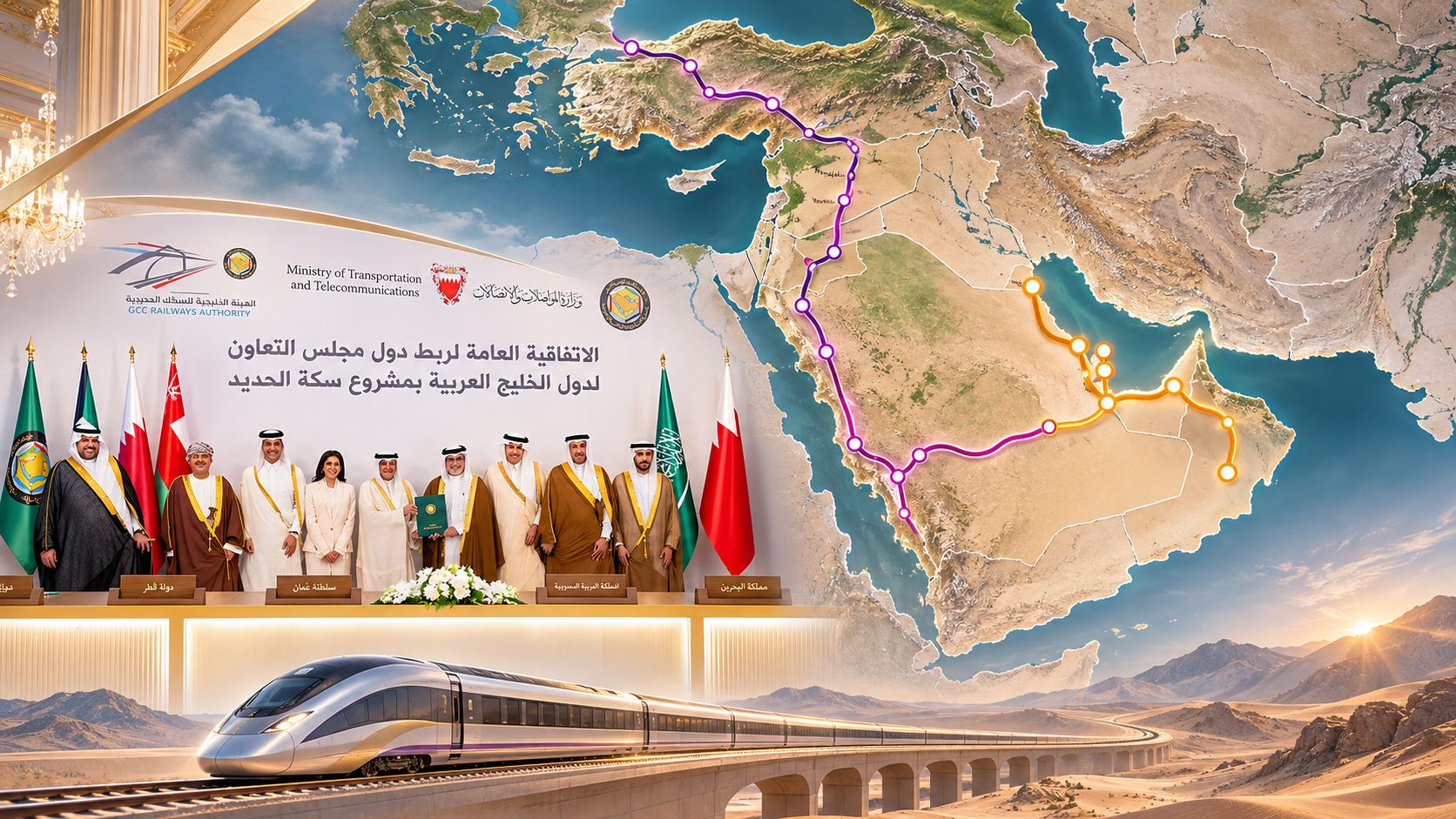
Zaviye Institute: The signing of the agreement to connect the railway networks of the six Gulf Cooperation Council countries in Bahrain on 8 November 2026 (17 Aban 1405) represents one of the region’s major infrastructure and railway developments. The significance of this agreement lies not only in the construction of a joint network, but also in its coincidence with efforts by Turkey, Saudi Arabia, Syria and Jordan to revive the Hejaz Railway and establish a land route between the Persian Gulf and Europe. One important point must be made here: a distinction should be drawn between progress on the Gulf railway project and the realisation of the historic Hejaz connection.
The Hejaz Railway, constructed at the beginning of the twentieth century with the aim of connecting Damascus to Medina, is now being redefined in a different form. Whereas the transfer of pilgrims and the consolidation of the Ottoman Empire’s political ties were previously its main objectives, the new approach is based on freight transit, market connectivity, supply-chain security and the diversification of trade routes. Accordingly, reviving the Hejaz Railway does not necessarily mean reconstructing the historic lines exactly as they were; rather, it will entail creating a modern corridor that leverages the geographical position of the former route.
Read more: Turkey Unveils Its Ambitious Plan to Extend the Hejaz Railway to Oman
According to published reports, the Gulf railway project is scheduled for completion by December 2030 (Azar 1409), with the aim of connecting Saudi Arabia, Kuwait, Bahrain, Qatar, the UAE and Oman. The latest figures indicate that the project is approximately 56 percent complete. The Manama agreement also provides a framework for implementation coordination, the harmonisation of technical standards, safety requirements and joint operations. Nevertheless, no formal commitment to directly connect this network to the Hejaz Railway appears in the published text of the agreement.
Another important development was the railway understandings reached between Ankara and Riyadh in June 2026 (Khordad/Tir 1405). Turkey’s Transport Minister Abdulkadir Uraloğlu announced a target of three to four years for connecting Saudi Arabia to Turkey via Jordan and Syria. In addition to the transport of passengers and goods, this plan has the potential to establish logistical links with European markets. However, approximately 400 kilometres of missing or yet-to-be-constructed connections along the Syrian and Jordanian sections, the destruction of Syria’s infrastructure and the uncertainty surrounding financing are among the main obstacles to its realisation.
In the latest development, on 9 November 2026 (18 Aban 1405), Syria’s official news agency reported that plans to revitalise the Hejaz Railway were being examined in Damascus. The programme includes developing suburban passenger lines around the capital, a possible connection to the Jordanian border and the development of historical routes for tourism. A trial journey by a tourist train in Damascus also indicates that initial technical measures have begun, but these activities do not yet signify the reopening of the international Hejaz corridor. Syrian officials had previously spoken of exploring the mobilisation of World Bank financial assistance for the reconstruction of the country’s railway network.
From a geoeconomic perspective, disruptions to shipping in the Strait of Hormuz and the consequences of regional warfare have increased Arab countries’ incentive to develop alternative routes—although their realisation is by no means straightforward. Connecting the Gulf railway to Red Sea and Mediterranean ports and to Turkey’s transport network could strengthen the region’s trade resilience. Nevertheless, railways will not fully replace maritime transport or energy pipelines, as their economic competitiveness will be determined by freight capacity, transport costs, route security and border formalities.
Read more: The Battle of the Corridors: The “Hejaz Railway” versus IMEC in the Region
For Iran, these developments could have significant implications. If realised, the formation of a northern route from the Persian Gulf to Europe could divert part of the region’s transit flows away from routes dependent on Iran’s geography. Conversely, completing Iran’s railway corridors to Iraq, Turkey, Central Asia and the southern ports, together with facilitating transit and reducing logistics costs, would enable the country to preserve and strengthen its position in the competition over regional corridors.
Overall, as of November 2026 (Aban 1405), the Hejaz Railway remains a project at the stage of understandings, studies and limited infrastructure reconstruction, rather than an operational and integrated network. The Manama agreement has created a more favourable economic and institutional environment for its development, but the project’s future depends on stability in Syria, Jordanian participation, capital mobilisation and multilateral agreements. The strategic importance of the current transformation lies less in reviving a historic railway than in the possibility of a new axis connecting the Arabian Peninsula to Europe and gradually reshaping the Middle East’s transit balance.
Read more: The Dimensions and Challenges of the Hejaz Railway Revival Initiative
Reader comments