
Defence Cooperation, Nuclear Energy and Technology: Pillars of the Emerging Economic Alliance between Ankara and Seoul
Erdoğan’s Visit to South Korea: Strategic Objectives and Regional Implications
 M
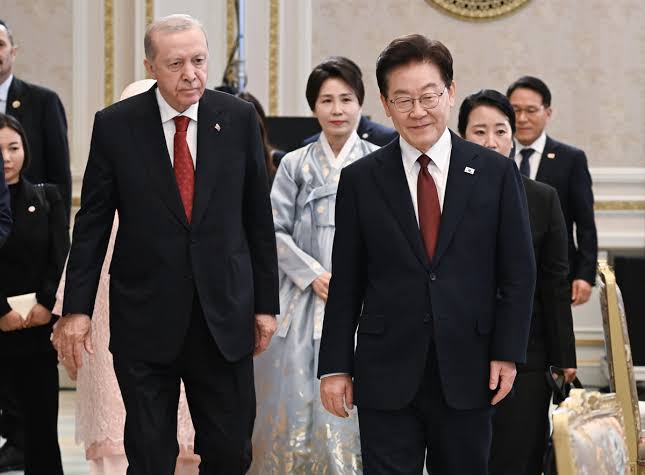
Zaviye Institute: Turkish President Recep Tayyip Erdoğan’s recent visit to South Korea from November 2 to 4, 2026, and his meeting with South Korean President Lee Jae-myung marked Erdoğan’s first visit to South Korea since 2018. It took place at a time when great-power competition, the reconfiguration of supply chains, the growing importance of strategic technologies, and the increasing linkage between economics and security have transformed the pattern of cooperation among states. From this perspective, the rapprochement between Ankara and Seoul reflects the efforts of two industrial and regional powers to expand their economic, technological, and geopolitical capacities in a complex and competitive environment.
Read more: The Middle Corridor: Turkey’s $30 Billion Bet on Eurasian Trade
The Geopolitical Logic: Linking Two Strategic Regions
Despite their geographical distance, Turkey and South Korea occupy distinct positions that complement each other. Turkey lies at the intersection of Europe, West Asia, and the Black Sea, while South Korea is one of the leading technology and industrial powers in East Asia. Turkey’s membership in NATO and South Korea’s security alliance with the United States also provide a basis for cooperation between the two countries.
Within this framework, Ankara’s efforts to develop relations with Seoul can be interpreted as part of a policy of diversifying its economic and technological partners without severing its Western ties. For South Korea, Turkey could serve as a base for access to the markets of Europe, the Middle East, Central Asia, and Africa. Accordingly, the two countries’ cooperation rests not only on commercial interests but also has the potential to shape a network of extra-regional partnerships.
Nuclear Energy: A Decisive Pillar of New Cooperation
One of the most important areas of discussion was the possible participation of South Korean companies in the construction of the Sinop nuclear power plant on the Black Sea coast. According to Seoul’s official statement, the two sides reviewed progress in technical negotiations and signed a memorandum of understanding on the financing of nuclear projects. This agreement follows the November 2025 nuclear understanding.
For Turkey, the strategic importance of this issue lies in reducing dependence on energy imports, diversifying technology suppliers, and attracting foreign investment. South Korea, meanwhile, is seeking to strengthen its position in the international nuclear power plant market. However, the signing of a financing memorandum does not mean that a construction contract has been finalized; issues related to financing, electricity-generation costs, and technical conditions remain decisive.
Read more: Why Is Turkey Pursuing Thorium Reactors?
Defense Industries: Moving from Bilateral Cooperation to Third-Party Markets
Defense cooperation was the second main pillar of the visit. The two countries’ experience of participating in the Fırtına howitzer and Altay tank projects has provided a foundation for expanding new areas of cooperation. The two leaders emphasized increasing joint production, transferring and developing technology, and examining the possibility of jointly exporting defense equipment to third countries.
From a strategic perspective, Turkey is seeking to strengthen the indigenous capabilities of its military industries and expand its export capacity, while South Korea can gain access to new networks of defense customers through cooperation with Ankara. However, the success of this cooperation will depend on restrictions on technology exports, competition among companies, and the compatibility of the two countries’ security interests.
Economy and Technology: Moving toward Industrial Partnership
Increasing bilateral trade from approximately $11 billion to a target of $15 billion, revising the free-trade agreement, and removing investment barriers were among the other issues discussed. Four memoranda of understanding were signed in the fields of science and innovation, natural resources and mining, energy, and nuclear financing. Cooperation in artificial intelligence, biotechnology, advanced materials, and critical minerals was also placed on the agenda.
These developments indicate that Ankara is seeking to move beyond relations based on the exchange of goods toward participation in higher-value-added production chains. For Seoul, Turkey can also be an important industrial and logistical partner in diversifying markets and supply chains. However, the trade imbalance and investment barriers remain challenges to achieving these objectives.
Regional Implications
The visit is also politically significant. Erdoğan’s support for Seoul’s approach toward North Korea, along with the two sides’ agreement to continue consultations on issues relating to the Middle East and Ukraine, indicates an effort to add a diplomatic dimension to their economic and industrial partnership.
For Iran, the development of Turkey–South Korea relations has two possible implications: first, strengthening Turkey’s technological and industrial capabilities and increasing its competitiveness in regional markets; and second, expanding Asian cooperation networks that could affect regional patterns of investment and trade. However, contrary to certain existing views, this trend does not necessarily signify the formation of an alliance against Iran, and such an interpretation is not consistent with the publicly stated evidence from the meeting.
Conclusion
Erdoğan’s visit to Seoul can be regarded as a sign of the gradual evolution of Turkey–South Korea relations from traditional economic cooperation toward a multilayered partnership encompassing energy, defence, technology and diplomacy. Its significance lies less in the number of agreements signed than in linking South Korea’s industrial capacity with Turkey’s geopolitical position and regional market.
Accordingly, the main criterion for assessing the visit’s outcomes will be the conversion of memorandums of understanding into implementable contracts, actual investment and joint projects. From the perspective of Iran’s foreign policy, monitoring these developments and identifying opportunities for technological and industrial cooperation with Asian actors are important for maintaining the country’s competitive position in the region’s geoeconomic environment.
Reader comments