
From Arms Imports to Military Self-Reliance and Shifting the Balance of Power in the South Caucasus
Development of Azerbaijan’s Defense Industry: Baku’s New Strategy for Military Power
 B
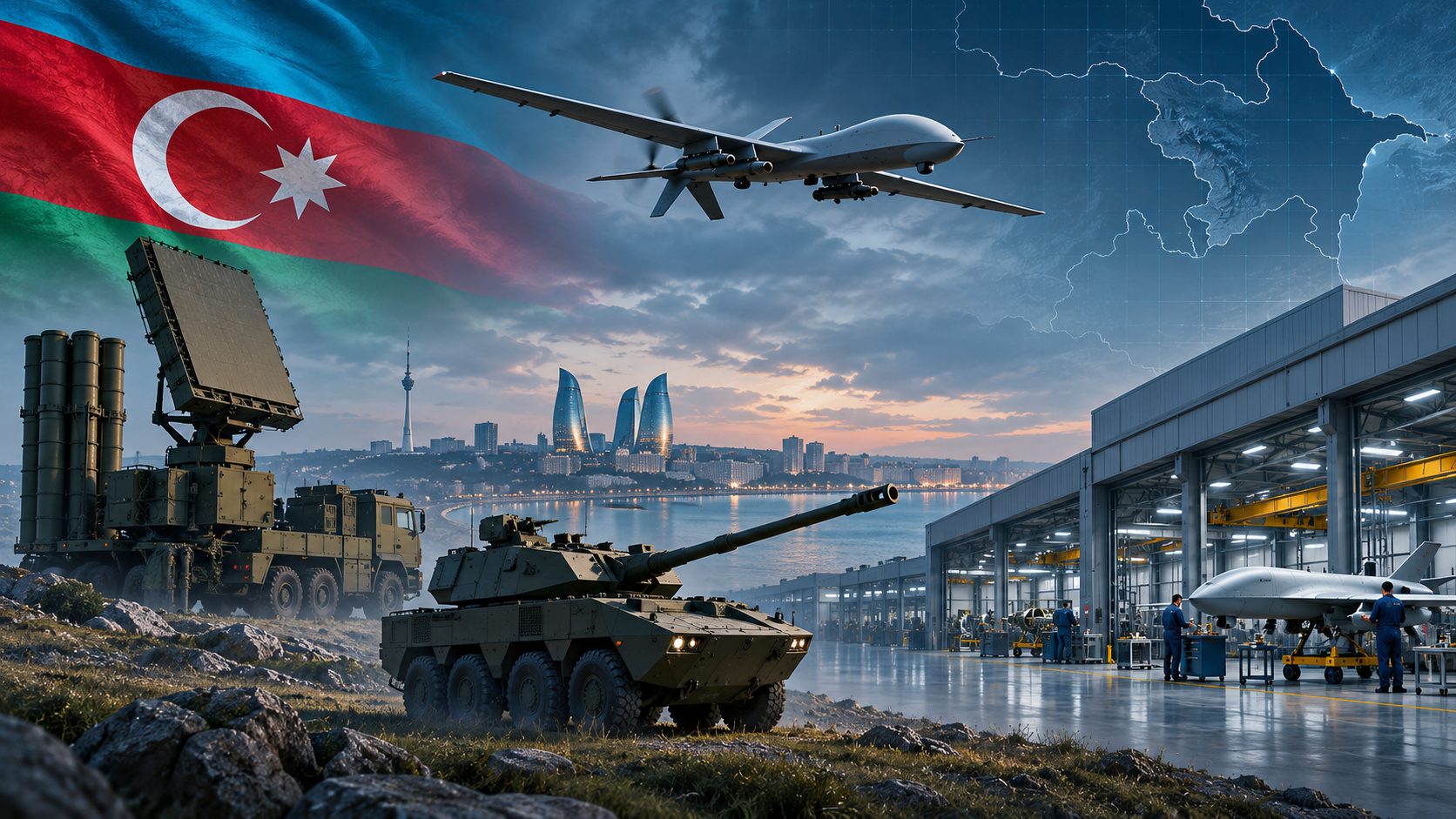
Zaviye Institute: The military and defence developments in the Republic of Azerbaijan in recent months clearly indicate that the country has entered a new phase of rebuilding its military power and redefining its position in the security dynamics of the South Caucasus. Over the past two decades, Baku has supplied the bulk of its military capabilities through imports of advanced weaponry, particularly from Turkey and Israel. It is now seeking to move towards developing domestic defence industries, transferring technology and jointly producing military equipment.
This shift in approach can be viewed as part of Azerbaijan’s broader strategy to consolidate its military superiority, reduce vulnerabilities in its arms procurement and increase its freedom of action in foreign policy.
The holding of the ADEX 2026 International Defence Exhibition in Baku, with the participation of 277 companies and organisations from 30 countries, is one of the most prominent manifestations of this transformation. The significance of the exhibition lay not merely in showcasing military equipment, but in Baku’s efforts to expand industrial and technological ties with new partners and transform arms relations into long-term defence cooperation.
The conclusion of defence contracts worth more than $500 million with Turkey in September 2026, covering radar systems, coastal defence equipment, loitering munitions and joint-production programmes, signals a move towards creating domestic support and military-equipment production capabilities. In this context, the preliminary agreement to establish joint-production facilities in Nakhchivan with the cooperation of Aselsan is of particular importance.
Read more: Azerbaijan Among Arms-Exporting Countries: Progress and Obstacles
At the same time, the expansion of cooperation with European companies, particularly the Czech industrial group CSG, to gradually produce self-propelled artillery systems from 2027, reflects Azerbaijan’s efforts to diversify the sources of its military technology. This trend shows that Baku does not intend to limit the development of its defence industries solely to cooperation with Turkey, but is seeking to draw on the technological capabilities of various countries to strengthen its defence infrastructure. However, achieving military self-reliance requires access to technical know-how, the capacity to produce strategic components and reduced dependence on foreign supply chains—objectives that will be difficult to achieve in the short term.
From a strategic perspective, the experience of the Karabakh wars has played a decisive role in shaping this approach. The military operations of 2020 and 2023 revealed the importance of advanced technologies, drones, reconnaissance systems and precision weapons to Azerbaijan’s military successes. Baku is now seeking to convert this operational experience into a sustainable capability that will enable it both to maintain its military superiority over Armenia and to increase its ability to manage potential future crises more independently. In this context, the development of defence industries is viewed not only as a means of enhancing combat capabilities, but also as a factor in strengthening deterrence and consolidating Azerbaijan’s regional position.
Another dimension of this transformation is its connection with Baku’s multilateral foreign policy. Through expanding military and industrial cooperation with Turkey, Israel, Pakistan and several European countries, the Republic of Azerbaijan is seeking to create a diverse network of defence partners. Such a network could reduce dependence on any one supplier and increase the country’s diplomatic room for manoeuvre. Nevertheless, dependence on foreign technology, training and support will remain one of the fundamental constraints on this strategy. Accordingly, the development of defence industries does not necessarily mean complete military independence; rather, it may lead to a reconfiguration of the pattern of defence dependencies.
Read more: Azerbaijan–UAE Relations: A New Energy and Security Alliance in the South Caucasus
At the regional level, an important consequence of this trend is the possible consolidation of the military asymmetry between Azerbaijan and Armenia and the gradual transformation of the deterrence pattern in the South Caucasus. Increased domestic production capacity could strengthen the ability to sustain military operations and replace equipment during a crisis. However, the ultimate direction of these capabilities will depend on developments in the peace process, regional security arrangements and Baku’s relations with neighbouring powers.
Overall, the development of the Republic of Azerbaijan’s defence industries should be understood as part of the country’s effort to transform the military superiority gained through the Karabakh wars into sustainable defence power and an instrument of influence in foreign policy. For the Islamic Republic of Iran, the significance of this transformation lies less in any immediate increase in the military threat than in the long-term implications of changes in the balance of power, the expansion of Baku’s defence cooperation with extra-regional actors and the development of military infrastructure in Nakhchivan.
Reader comments