
Examining the Geopolitical Dimensions of Moscow’s Rapprochement with the Organization of Turkic States
Will Russia Join the Organization of Turkic States?
 Z
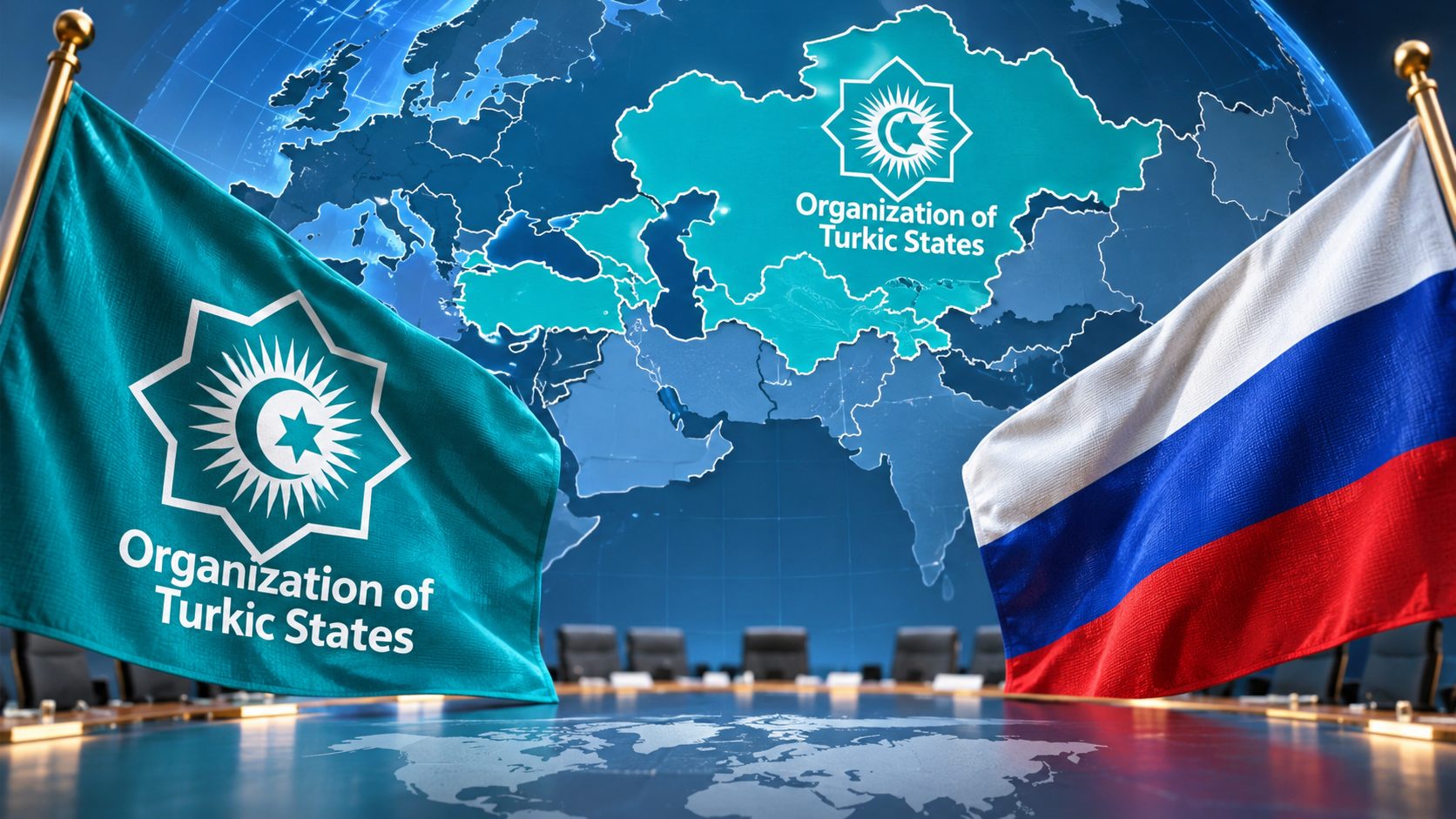
Zaviye Institute: Recent developments surrounding the possibility of Russia joining the Organization of Turkic States point to the emergence of a new phase in Eurasia’s geopolitical relations. The organization, initially established to strengthen the cultural, linguistic and historical ties among Turkic-speaking countries, has now become one of the important frameworks for political, economic and transit cooperation in Central Asia and the Caucasus.
Read more: The Organization of Turkic States: From Common Identity to Regional Power
The Kremlin’s recent welcome for the possibility of participation in this organization raises an important question: Is Russia reconsidering its traditional view of pan-Turkic integration, or is it seeking to manage the organization’s evolution through its presence within this structure?
The starting point for this discussion was a proposal by Kassym-Jomart Tokayev, President of Kazakhstan, at the 13th summit of the Organization of Turkic States in Ankara on October 30, 2026 (8 Aban 1405). Tokayev proposed that Russia participate in the organization through the “Organization of Turkic States Plus” mechanism or hold observer status in its activities. On November 2, Kremlin spokesman Dmitry Peskov described the idea as understandable and appropriate, saying that the matter would be discussed in Moscow–Astana relations, although no formal invitation had yet been received. Therefore, contrary to some media interpretations, neither an official Russian membership request has so far been confirmed nor has any decision been made to accept it.
The significance of this development becomes clearer when Russia’s previous approach to the Organization of Turkic States is taken into account. In recent years, Moscow has closely monitored integration among Turkic-speaking peoples and has expressed concerns about the expansion of Turkey’s cultural and political influence in Central Asia and even in the Turkic-populated regions of the Russian Federation. It now appears that rather than distancing itself from this trend, Russia is examining the possibility of participating in it. This approach can be viewed as a form of pragmatic adaptation to the region’s new realities.
Moscow’s first possible motivation is to preserve its influence in Central Asia. Kazakhstan, Kyrgyzstan and Uzbekistan, despite their historical and economic ties with Russia, have in recent years shown greater interest in expanding their relations with Turkey, China, Europe and other actors. The Organization of Turkic States is one of the instruments of this diversification. Russia’s participation in the organization’s activities could increase its opportunities for direct dialogue with members and its ability to influence regional agendas.
Read more: How Has the Ukraine War Affected Russia’s Influence in Central Asia and the South Caucasus?
The second motivation relates to geo-economic competition. The development of the Middle Corridor, which connects China and Central Asia to Europe via the Caspian Sea, Azerbaijan and Turkey, has increased the importance of transit routes outside Russian territory. Through engagement with the Organization of Turkic States, Moscow can participate in discussions on transport, energy and regional connectivity instead of merely confronting these developments. Nevertheless, Russia’s interests and those of some members do not necessarily coincide on transit routes.
The third factor is the issue of Turkic-origin ethnic groups within the Russian Federation. Tatarstan, Bashkortostan, Sakha and other Turkic-populated regions have extensive historical and cultural ties with the Turkic world. Peskov’s emphasis on the participation of “the Russian Federation as a whole,” rather than individual regions, is significant in this regard. This position may indicate Moscow’s desire to centrally manage the cultural and cross-border relations of these regions—an issue that has also been important in Russia’s relations with the Turkic world’s cultural institutions in the past.
Nevertheless, Russia’s acceptance faces political and institutional obstacles. The Organization of Turkic States is founded on the shared linguistic and cultural identity of its members, and the entry of a non-Turkic-speaking power such as Russia could generate debates about its identity and future. Kürşad Zorlu, an official of Turkey’s ruling party, emphasized on November 4 that any Russian request should be considered with the consent of the members and in accordance with the organization’s regulations. Accordingly, the “Turkic Plus” cooperation mechanism will likely offer greater flexibility than observer or full membership.
For Turkey, too, this development has dual implications. On the one hand, Russia’s participation could increase the organization’s international weight; on the other, the presence of a power with Moscow’s political and security capabilities could affect the members’ decision-making autonomy. Kazakhstan is also likely seeking to strike a balance between cooperation with Russia and strengthening its relations with the Turkic world.
From Iran’s perspective, these developments warrant particular attention. Expanded cooperation between Russia and the Organization of Turkic States could affect the equations of the South Caucasus, Central Asia, transit corridors, and Turkish–Russian relations. For Tehran, the main issue is not merely the possibility of Moscow’s membership, but rather how the organization evolves from an identity-based framework into a broader mechanism for geo-economic and political cooperation.
Overall, Russia’s welcome of participation in the Organization of Turkic States can be regarded as a sign of a change in Moscow’s approach to dealing with Turkic integration, rather than necessarily a change in its strategic objectives. Russia appears to have come close to the conclusion that engagement with an expanding regional structure could offer more opportunities than distancing itself from it. Nevertheless, the fate of this initiative will depend on agreement among the members, the legal form of participation, and the extent to which Russia’s interests are compatible with the organization’s objectives.
Reader comments