
The Ukraine War and the Changing Balance of Power in Eurasia
What Impact Has the Ukraine War Had on Russia’s Influence in Central Asia and the South Caucasus?
 M
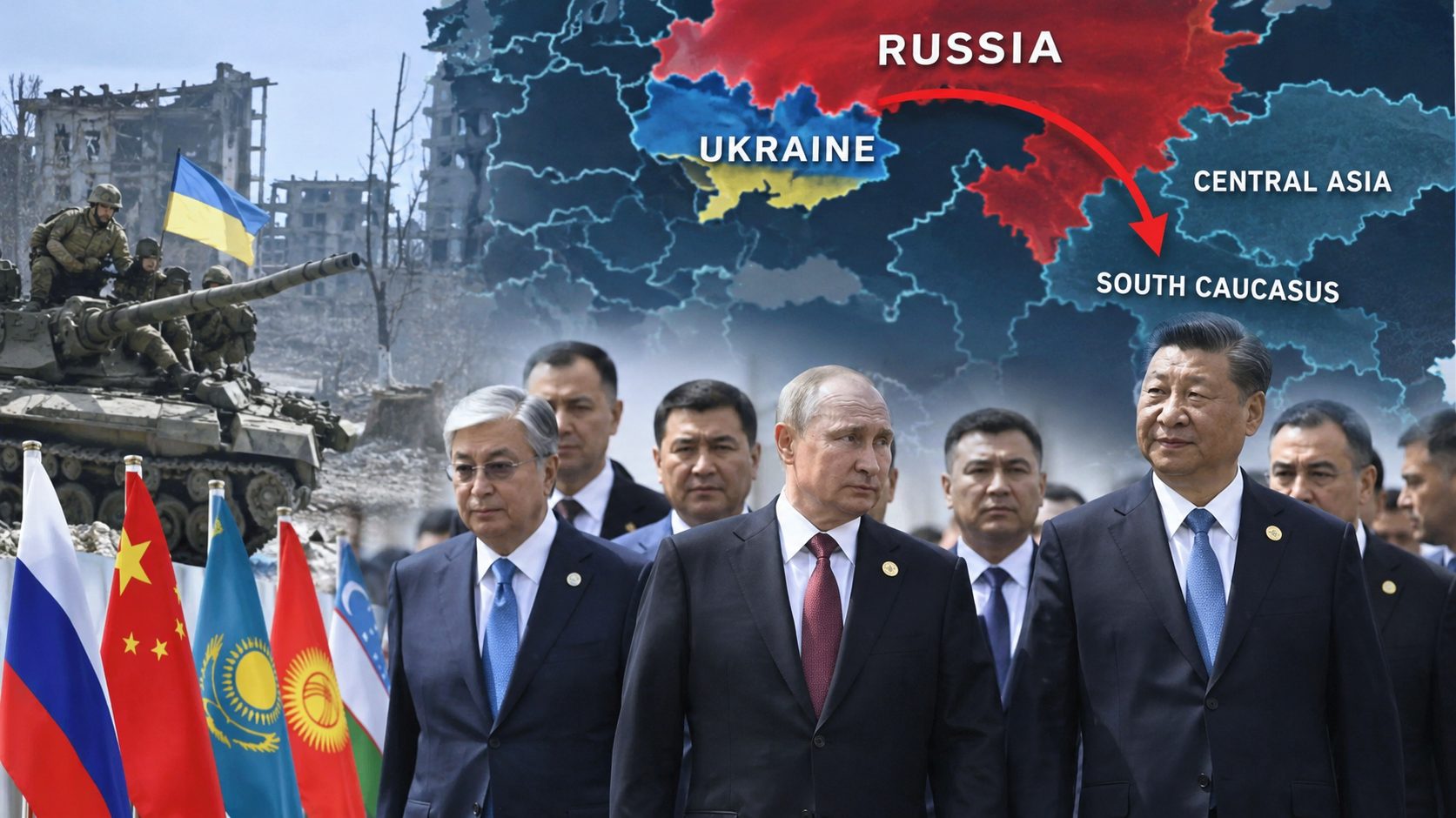
Zaviye Institute: The war in Ukraine, beyond being a military conflict in Eastern Europe, has become a turning point in the transformation of Eurasia’s geopolitical order. Its most important consequence for Russia has not been its complete withdrawal from Central Asia and the South Caucasus, but rather the erosion of Moscow’s monopolistic position and the decline of its ability to set the security and political rules in these two regions.
By contrast, China in Central Asia, Turkey in the South Caucasus, and the United States and the European Union in both regions have gained greater opportunities to expand their influence. Nevertheless, economic, energy, migration and infrastructure dependencies remain important levers for Russia. The principal trend should therefore be understood as a transition from Russian dominance to multilateral balancing, not Moscow’s removal from the regional equation.
Central Asia; Declining Security Influence and Continuing Economic Dependence
Russia’s invasion of Ukraine in February 2022 (Bahman 1400) undermined Moscow’s credibility as the guarantor of security for the Central Asian republics. The concentration of Russia’s military resources on the Ukrainian front has limited the country’s capacity to manage crises in its surrounding regions. The diminished role of the Collective Security Treaty Organization and the transfer of some forces stationed in Tajikistan and Kyrgyzstan to the war in Ukraine are among the indications of this shift.
Nevertheless, declining security influence does not mean the collapse of economic influence. Russia’s trade with Central Asia reached approximately $51 billion in 2025. Part of this growth resulted from the rerouting of trade and the re-export of goods under the conditions of sanctions against Russia.
Kazakhstan and Uzbekistan, while maintaining economic relations with Moscow, have strengthened their multilateral foreign policies. These countries do not want to replace dependence on Russia with exclusive dependence on another power.
China; The Biggest Relative Winner in Central Asia
China has taken advantage of the relative power vacuum left by Russia to expand its economic and infrastructure influence. China’s trade with Central Asia reached approximately $106 billion in 2025, a figure far higher than Russia’s trade with the region. The development of rail lines, investment in energy, strategic minerals and transport corridors has strengthened Beijing’s position.
Nevertheless, relations between Russia and China in the region are not solely competitive. Moscow still possesses security capabilities and historical ties, while Beijing prefers to expand its economic influence without assuming all of the region’s security costs.
The strategic outcome is that a form of unequal and fragile division of labor is taking shape between Russia and China: China is becoming the more dominant economic power, while Russia is striving to preserve its security and political role.
South Caucasus; Russia’s Most Evident Geopolitical Retreat
Russia’s weakening influence in the South Caucasus has been more pronounced than in Central Asia. Azerbaijan’s recapture of Karabakh in September 2023, without effective Russian intervention, damaged Moscow’s credibility as the guarantor of the region’s security arrangements.
Armenia, too, by suspending its participation in the Collective Security Treaty Organization in 2024, gradually moved toward diversifying its security partners. On the other side, Azerbaijan, relying on strategic cooperation with Turkey, gained greater room for maneuver vis-à-vis Moscow.
The Washington agreements in August 2025 (Mordad 1404) between Armenia and Azerbaijan, and the plan for the so-called TRIPP route, signal the more active entry of the United States into the Caucasus’s transit dynamics. The U.S. vice president’s visit to Armenia and Azerbaijan in February 2026 (Bahman 1404) further reinforced this orientation.
Nevertheless, Russia’s military presence in Armenia and in the regions of Abkhazia and South Ossetia in Georgia shows that Moscow still possesses instruments of pressure.
Read more: The Caucasus After Moscow’s Monopoly; Transition to a Balance Without a Guarantor
Corridor Competition; The Geopolitical Transfer of Power from the Military to the Economic Sphere
One of the most important consequences of the war in Ukraine has been the growing importance of the Middle Corridor, the Trans-Caspian route, and connecting Central Asia with Europe without passing through Russia. The European Union, China and Turkey each support the development of this network for different reasons.
Nevertheless, military developments in the Middle East in 2026 and insecurity along southern routes have shown that fully replacing Russia’s routes is difficult. As a result, Moscow can still use its geographical position and transit capacity to preserve its influence.
Strategic Outlook and Three Possible Scenarios
First scenario, the continued erosion of Russia: A prolonged war in Ukraine, together with sanctions, will lead to the expansion of China’s, Turkey’s and the West’s influence and to greater independence in the decision-making of regional countries.
Second scenario, Russia’s partial return: A reduction in tensions in Ukraine and the release of military and economic resources would enable Moscow to recover part of its influence, although a return to its former monopolistic position is unlikely.
Scenario Three: Consolidation of a Multipolar Order: The most likely scenario is the formation of a fluid balance in which Russia, China, Turkey and the West will be compelled to compete and cooperate simultaneously. The September 2026 analysis by the Middle East Council likewise emphasises Central Asia’s movement towards multipolarity.
Conclusion
The war in Ukraine has reduced Russia’s influence from a hegemonic position to that of one among several influential powers. In the South Caucasus, this change is primarily security-related and political in nature, while in Central Asia it has manifested largely through heightened economic and diplomatic competition.
For Iran, this development creates both opportunities and threats. The erosion of Russia’s monopoly creates scope for expanding independent relations with the region’s republics; however, the expansion of Turkey’s, China’s and the United States’ influence, together with changes in transit routes, could place Iran’s geoeconomic position under pressure.
The Islamic Republic of Iran should, alongside strategic engagement and coordination with Russia, pursue a balanced policy centred on strengthening the North–South Corridor, expanding direct cooperation with Central Asia, preserving strategic ties with Armenia and developing relations with the Republic of Azerbaijan. The objective should be to turn Iran into an indispensable actor in the Eurasian connectivity network, rather than merely reacting to competition among the great powers.
Reader comments