
The Implications of Trump’s and the Republicans’ Defeat for Erdoğan and the Justice and Development Party
With the Republicans’ Defeat in the United States, Has Ankara’s Era of Political Influence in Washington Come to an End?
 Z
Zaviye Institute: The Republicans’ defeat in the November 3, 2026, U.S. midterm elections was not merely a defeat for the Republican Party and Donald Trump personally; it also represented a setback for many around the world who had placed their bets on the Republicans and Trump.
Within this framework, and if we examine the issue specifically in relation to Turkey, its government and the ruling party, the Democrats’ victory and simultaneous capture of majorities in both the House of Representatives and the Senate have effectively weakened one of the most important political pillars of the Erdoğan government in Washington. The significance of this development for Ankara is all the greater because, in recent years, the Turkish government had based a considerable part of its strategy toward the United States on Erdoğan’s personal relationship with Trump, influence within the Republican political network, and the White House’s transactional approach.
From January 2027, Trump will face, for the first time during his second presidency, a Congress in which both chambers are controlled by his political opponents. This shift in the balance of power does not merely mean that the passage of the U.S. administration’s proposals will become more difficult; it also signifies a change in the political and oversight environment in which Erdoğan operates.
The Weakening of Erdoğan’s and Trump’s Personal Diplomacy
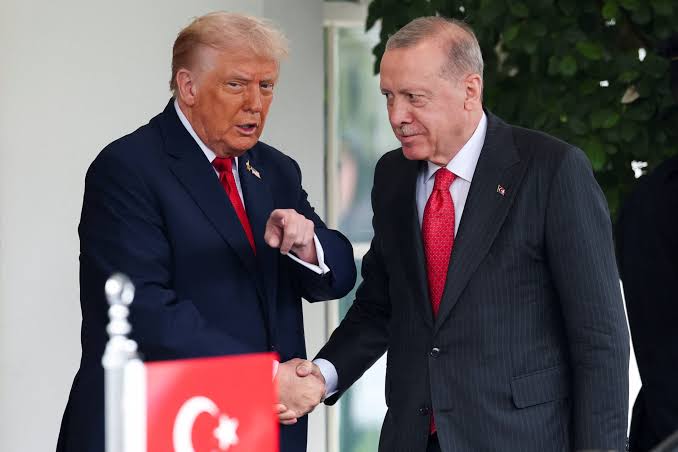
One of the important features of Turkey’s foreign policy during Trump’s second presidency has been a partial departure from traditional diplomatic channels and reliance on direct communication between leaders. Erdoğan had understood well that, unlike the Biden administration, Trump was more inclined to engage with charismatic and powerful leaders, including leaders accused of authoritarianism—particularly if such relationships could lead to security, economic and regional agreements.
A Brookings Institution analysis of Turkey’s position in the Middle Eastern order emphasizes that no relationship has had as much influence on Turkey’s regional standing as the personal relationship between Erdoğan and Trump. This relationship enabled Ankara to communicate directly with the U.S. president’s inner circle, including Steve Witkoff, Jared Kushner and Tom Barrack, and expanded Turkey’s room for maneuver in cases such as Syria.
But the central issue is that personal diplomacy remains effective only as long as the U.S. president enjoys sufficient political and institutional backing. The Republicans’ defeat has seriously called this assumption into question. From now on, even if Trump remains favorably disposed toward Erdoğan, implementing his potential agreements with Turkey on issues such as the sale of F-35 fighter jets, the lifting of sanctions and military cooperation will face more serious obstacles.
In other words, Erdoğan may still have access to the White House, but access to the White House will no longer mean influence over policymaking processes or a guarantee of Washington’s support.
Read more: The Impact of the Trump–Erdoğan Meeting on the Region, Defense and Energy
Congress’s Return as the Main Obstacle in the Turkey Dossier
One of the most important consequences of the Republicans’ defeat is the revival of Congress’s oversight role in Turkey policy. In recent years, some Republican lawmakers had been cautious about publicly criticizing Ankara’s policies because of Trump’s close relationship with Erdoğan. With the change in the majority, this political consideration will be significantly weakened.
A report by the Congressional Research Service (CRS) in August 2026 (Mordad 1405) explicitly shows that the structural disputes between Washington and Ankara remain unresolved: Turkey’s purchase of the S-400 system from Russia, U.S. cooperation with the Syrian Democratic Forces, human rights issues, and disagreements over Turkey’s regional policy. The report also emphasizes that Congress has numerous legal tools at its disposal to influence arms sales and the lifting of sanctions.
The F-35 case is particularly important in this regard. Erdoğan continues to seek Turkey’s return to the program for producing and receiving these fighter jets, as well as the lifting of sanctions related to the S-400. However, U.S. law makes the transfer of F-35s to Turkey conditional on abandoning the Russian system.
The significance of the new developments becomes clearer when we note that, in July 2026 (Tir 1405), a group of U.S. lawmakers wrote to Trump objecting to the sale of these fighter jets without Ankara first making substantial concessions. In another letter, lawmakers also expressed concern about the U.S. administration’s personal ties with Turkey and the possibility of circumventing legal requirements. The CRS has documented these objections and the differing positions of lawmakers.
Accordingly, the Democrats’ victory could transform the F-35 case from an issue that can be resolved through bilateral negotiations between leaders into a serious dispute at the level of U.S. legislative institutions.
The Turkish Lobby and the Personalization of U.S. Foreign Policy
One of the most sensitive aspects of this development is the future of the Erdoğan government’s influence and lobbying network within the U.S. political system. In recent years, Ankara has sought, through contacts with Republican lawmakers, political institutions, pressure groups, consulting firms and Trump’s inner circle, to portray Turkey as an indispensable U.S. partner in NATO and the Middle East.
Such activities are not unusual in themselves; many governments use registered lobbyists to advance their interests in Washington. The issue becomes sensitive, however, when political influence is linked to leaders’ personal relationships and decision-making outside transparent institutional mechanisms.
Documents registered in the U.S. Department of Justice’s FARA system in January 2026 (Dey 1404) show that lobbying activities conducted on behalf of the Turkish government included direct contact with members of Congress and executive officials, monitoring legislative developments and efforts to advance policies favored by Ankara.
Democrats have consistently criticized the personalization of U.S. foreign policy and the reduction of strategic relations to ties between political leaders. In the case of Turkey, this criticism has been combined with concerns about the state of democracy, the detention of political opponents, pressure on the media and Erdoğan’s regional policies.
For example, the letter sent by Democratic lawmakers to Trump concerning the F-35 did not remain limited to military disagreements; it also raised questions about the Trump family’s ties to the Turkish government and the possibility that personal interests had influenced government decisions. The letter also referred to Donald Trump Jr.’s visit to Istanbul and related business and political contacts. These matters remain questions and allegations raised by lawmakers and should not be treated as proof of wrongdoing.
In reality, what is now showing cracks is not necessarily the foundation of Turkey-U.S. relations, but rather the possibility of advancing those relations through a personal channel that is largely indifferent to institutional opposition.
Rising Domestic and Regional Costs for Erdoğan
A Democratic victory could also impose costs on the Turkish government in three other areas.
First is the issue of democracy and human rights in Turkey. In recent years, the Erdoğan government has faced widespread criticism over restrictions on opposition activities, pressure on the Republican People’s Party (CHP), the detention of political figures and the weakening of the independence of judicial institutions. The return of Democrats to the chairmanship of key congressional committees would create greater opportunities for holding hearings, publishing critical reports and pursuing the situation of Turkey’s political opponents.
Second is the issue of Syria and the Kurdish forces. Although battlefield developments and Washington’s changing relationship with the Syrian Democratic Forces shifted in Ankara’s favor in 2026, this does not mean that strategic disagreements have been eliminated. The new Congress could raise more serious questions about the security implications of abandoning the United States’ former partners and about Turkey’s policy in northern Syria.
Third is the issue of Greece, Cyprus and the military balance in the Eastern Mediterranean. Any effort by the Trump administration to grant Turkey extensive military concessions without taking the concerns of other U.S. allies into account could face opposition from Democratic lawmakers and even from some Republicans.
A CRS report also shows that the issue of F-35 sales is not merely an arms deal; it is linked to the security considerations of Israel, Greece and NATO, as well as the possibility of Russia gaining access to sensitive military technologies.
Read more: How Will the U.S. Elections Affect Turkey’s Domestic Politics and Erdoğan’s Future?
Is Erdoğan on the Verge of a Reassessment of U.S. Strategy?
Of course, the consequences of these elections should not be exaggerated. A Democratic victory would not mean the end of Turkey-U.S. strategic relations. Turkey remains an important NATO member, possesses a sensitive geopolitical position and is an influential actor in the affairs of Syria, Ukraine, the Caucasus and the Middle East. Washington cannot ignore these realities, regardless of which party holds a majority in Congress.
Democrats also lack the majority required to override a presidential veto, and in the Senate they have not secured the 60 votes needed to overcome the filibuster under normal procedures. They therefore cannot easily halt all of Trump’s policies toward Turkey. But this does not mean that the previous course of Turkey’s relations with Republicans and Trump himself will continue in the new period without significant cost or difficulty.
Nevertheless, an analytical report by the IstanPol Institute on the implications of the midterm elections makes an important point: Turkey’s geopolitical importance does not necessarily mean that the United States has institutional confidence in Erdoğan. The institute argues that a change in the congressional majority could elevate concerns about democracy and Turkey’s foreign policy from the level of political criticism to the level of influencing defense and diplomatic decisions.
Conclusion
The Republicans’ defeat in the 2026 midterm elections should be viewed by Erdoğan not as a direct diplomatic setback, but as the weakening of one of Turkey’s most important channels of political influence in the United States. In recent years, Ankara had invested in the belief that the close relationship between Erdoğan and Trump could resolve many of the two countries’ longstanding disputes through personal agreements and outside the usual pressures exerted by Congress.
This model now faces three simultaneous challenges: first, a decline in Trump’s political power within the legislative structure; second, an increase in the Democrats’ oversight and critical capacity; and third, the possibility that some Republicans will distance themselves from the political costs of unconditional alignment with the president.
Perhaps the most important message of these elections for Erdoğan is that a personal relationship with the U.S. president, however close and effective, cannot replace institutional consensus in Washington.
From this perspective, Turkey will face an issue in the years ahead that goes beyond a change in the congressional majority: the need to redefine its relations with a United States whose policies can no longer be understood solely through the lens of the Erdoğan–Trump relationship.
This development could mark the beginning of a period in which the Turkish government, in order to preserve its gains in Washington, will be compelled to seek the restoration of institutional ties and the establishment of bipartisan trust, rather than relying exclusively on the Republicans and Trump’s inner circle—a path that will not be particularly smooth without a reassessment of some of Ankara’s domestic and regional policies.
Reader comments