
From Economic Liberalization to Geopolitical Ambition
Turkey’s Economy: A 46-Year Journey from Neoliberalism to Regional Power
 D
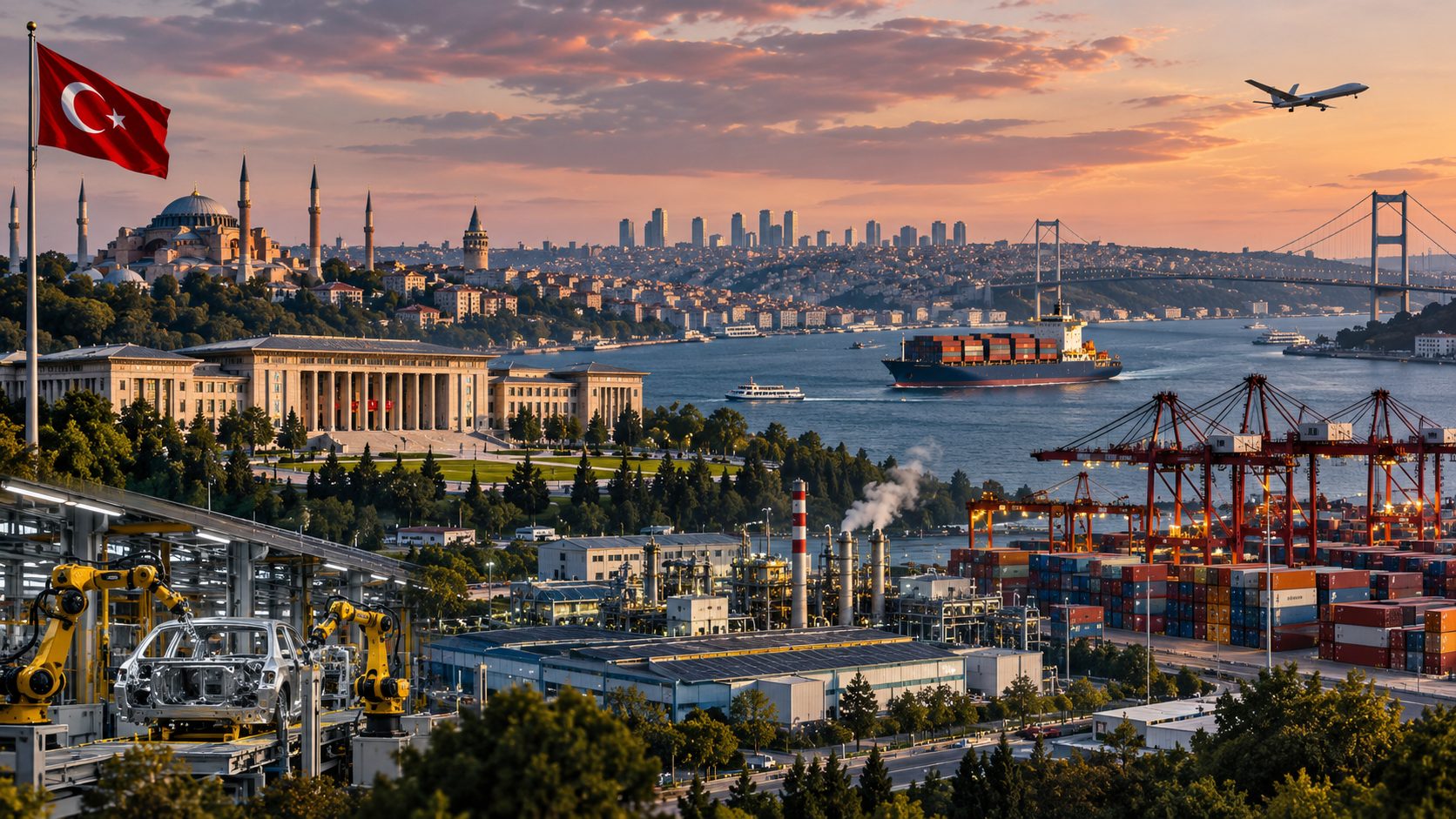
Zaviye Institute: Turkey’s transformations since 1980 cannot be understood merely as a transition from a state-controlled economy to a free market or as the transformation of a country dependent on the West into an active actor in the international system. These transformations reflect a redefinition of the relationship among the state, the market, society and the international system—a process in which Turkey has sought to enhance its position by leveraging economic globalization, its geopolitical position, trade networks, and military and cultural capabilities.
The central hypothesis of this analysis is that neoliberalism in Turkey has served not only as an economic model but also as a tool for reconstructing the state, forming new classes and expanding regional influence. While generating significant achievements, this model has also produced contradictions among economic growth, strategic autonomy, social justice and institutional stability.
The 1980s: The Beginnings of Neoliberalism and the Redefinition of the State
The economic crisis of the late 1970s and the 1980 military coup created the conditions for Turkey’s shift toward a market economy. The 24 January 1980 economic programme and the policies of Turgut Özal, particularly after 1983, focused on export development, reducing trade barriers, attracting foreign investment, foreign-exchange liberalization and expanding the private sector.
These policies contributed to the growth of industrial exports and the emergence of new entrepreneurs, particularly in Anatolian cities. Nevertheless, economic liberalization took place amid restrictions on workers’ rights and social organizations following the military coup. Turkey’s model was therefore marked from the outset by a fundamental contradiction: economic liberalization without commensurate political liberalization. The state withdrew from some forms of direct economic activity but retained its role in directing development and politically managing society.
The 1990s: Financial Integration and Economic Vulnerability
During the 1990s, Turkey became more deeply integrated into the global economy following the liberalization of capital movements in 1989. However, weak regulatory institutions, chronic inflation, budget deficits, the instability of coalition governments and dependence on foreign capital increased the economy’s vulnerability and contributed to the financial crises of 2000 and 2001.
At the same time, the Turkey–European Union Customs Union, signed in 1995 and implemented from 1996, strengthened Turkey’s industrial and trade ties with Europe. The experience of this decade showed that integration into the global economy does not necessarily lead to sustainable economic power without institutional stability and state regulatory capacity.
2001–2013: Structural Reforms and the Emergence of Economic Power
The 2001 crisis created the conditions for reforming the banking system, strengthening fiscal discipline and rebuilding economic policymaking. Following the Justice and Development Party’s rise to power in 2002, the attraction of foreign investment, infrastructure development, the expansion of credit and the strengthening of trade with Europe and regional markets accelerated.
The growth of the automotive, textile, household-appliance, construction and food industries, alongside the emergence of small and medium-sized Anatolian enterprises, strengthened the economic and social foundations of the new order. In its early years, the Justice and Development Party also reduced some of the traditional constraints of the political system through institutional reforms and advancing the process of membership in the European Union.
In foreign policy, Turkey expanded its relations with the Middle East, the Caucasus, Africa and Central Asia, turning trade, diplomacy and soft power into instruments of influence. However, the gradual concentration of executive power and the weakening of the independence of certain institutions laid the groundwork for subsequent challenges. The principal achievement of this period was the conversion of economic capacity into political and regional influence—not the attainment of full economic autonomy or the consolidation of democratic institutions.
2013–2020: The Erosion of the Growth Model and the Consolidation of Power-Centred Governance
From 2013 onward, the Gezi protests, political tensions, security crises, the failed coup attempt in 2016 and the establishment of the presidential system in 2018 transformed Turkey’s political and economic environment.
The growth model continued to rely on construction, credit, domestic demand and foreign financial resources. Dependence on energy and technology imports, the persistent need for foreign currency, declining confidence in the independence of the central bank and fluctuations in the lira exposed the limitations of this model.
In the external arena, Turkey also moved from a model of “integration through trade” toward a combination of economic, diplomatic and military instruments. Military operations in Syria, a more active presence in regional conflicts and the development of the defence industry indicated Ankara’s efforts to increase its strategic autonomy. However, strategic autonomy is not equivalent to economic self-sufficiency, as Turkey remains dependent on export markets, foreign technology, international capital and energy imports.
2020–2026: Global Opportunities and Structural Constraints
Developments in the international system, the war in Ukraine, conflicts in the Middle East and the reconfiguration of supply chains have created new opportunities for Turkey. Its geographical proximity to Europe, industrial infrastructure and logistical capacities have turned the country into an option for relocating or diversifying production chains. However, making sustainable use of these opportunities requires higher productivity, investment in technology and economic stability.
In the security sphere, the development of defense industries, particularly drones and military systems, has increased Turkey’s export capacity and regional influence. While retaining its NATO membership, Ankara is also pursuing a multidirectional foreign policy through economic ties with Europe, cooperation with Ukraine, and engagement with Russia and the countries of the Middle East.
Read more: The Fragility of Turkey’s Maritime Security Amid the Drone War
In the economic sphere, stabilization policies in recent years have contributed to a relative decline in inflation. According to the International Monetary Fund’s assessment in February 2026, annual inflation fell from 49.4 percent in September 2024 to 30.9 percent in December 2025. The IMF also estimated Turkey’s economic growth at 4.1 percent in 2025 and had forecast growth of 4.2 percent for 2026. Nevertheless, high inflation, declining purchasing power, the cost of living, and the need for external financing remain among the main challenges facing the Turkish economy.
Conclusion
Turkey’s developments from 1980 to 2026 can be explained through five strategic contradictions:
First, the contradiction between neoliberalism and a strong state: Turkey has used economic liberalization to expand domestic capitalism, while preserving the state’s role in allocating resources and directing major projects. Its model is therefore a combination of a market economy, selective state intervention, and the concentration of political power.
Second, the contradiction between growth and development: Increased production, exports, and infrastructure do not necessarily lead to higher productivity, social justice, and technological development. Escaping the middle-income trap depends on moving toward a knowledge-based economy.
Further reading: Turkey’s Generation Z: A Generation in Search of a Future
Third, the contradiction between strategic autonomy and interdependence: Turkey seeks to expand its regional freedom of action, but dependence on European markets, energy, technology, and foreign capital limits its room for maneuver. An effective strategy involves diversifying dependencies and increasing bargaining power.
Fourth, the contradiction between external power and domestic institutional capacity: Military and diplomatic influence will be sustainable only when accompanied by monetary stability, legal predictability, investor confidence, and effective governance.
Fifth, the contradiction between global opportunities and structural constraints: Geographical position and industrial capacity create opportunities to attract investment and relocate production chains, but taking advantage of them requires technological upgrading, education reform, and improvements in the quality of governance.
Ultimately, Turkey is neither a case of the complete failure of neoliberalism nor a model of its unequivocal success; rather, it is an example of the combination of a globalized economy, a centralized state, and geopolitical ambition. The country’s future will depend less on expanding military influence or increasing the volume of trade than on its ability to convert its geographical and political advantages into economic productivity, technological development, institutional stability, and social welfare.
Reader comments